
Your 80-Year-Old Self Will Thank You For Training Now
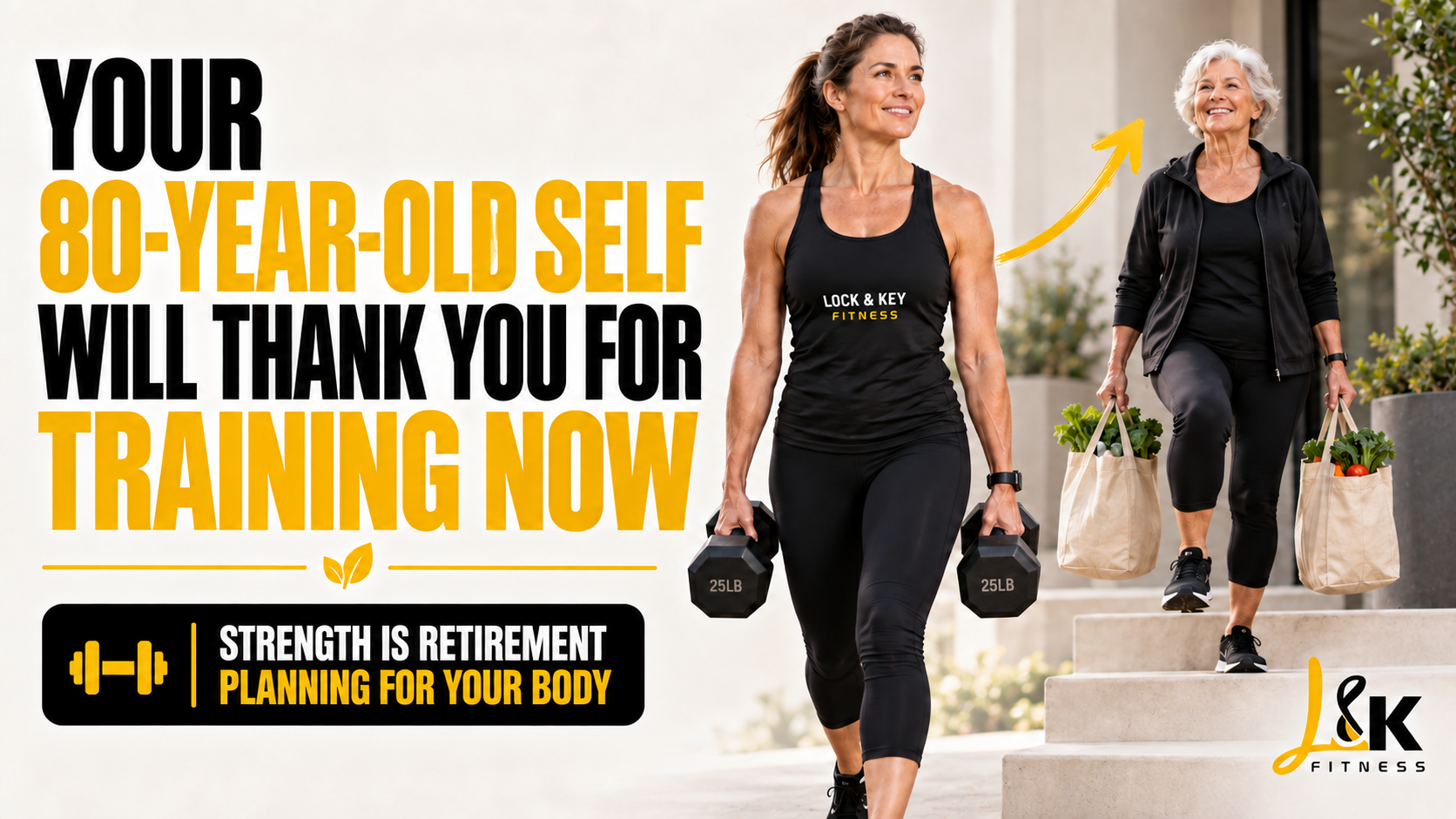
Most people don’t walk into the gym thinking about themselves at 80.
They’re thinking about losing 15 pounds.
Building their shoulders.
Getting their ass back.
Seeing their abs again.
Adding weight to the bar.
Feeling confident in a swimsuit.
And there’s absolutely nothing wrong with any of that.
But underneath all those short-term goals, you’re building something else.
Something you’ll hopefully still be using decades from now.
Physical capacity.
The ability to lift something heavy.
Get yourself off the floor.
Carry groceries.
Climb stairs.
Catch yourself when you stumble.
Travel.
Play with your grandkids.
Live independently.
Do cool shit with your body.
Because eventually, the question becomes less:
“How good can I look?”
And more:
“How much of my life can I still physically participate in?”
And there’s a pretty compelling argument for starting to answer that question long before you’re old.
Aging Happens. But You Can Build A Bigger Reserve
We’re not going to sell you some anti-aging fantasy.
You are going to age.
So are we.
Muscle mass tends to decline with age.
Strength declines.
Power declines.
Recovery can change.
Eventually, Father Time remains undefeated.
But there’s an important distinction between aging and simply surrendering physical capacity because aging exists.
Think about two people eventually experiencing some of the normal physical decline that comes with getting older.
One enters later life strong, active, muscular, and physically capable.
The other enters it already weak, sedentary, and struggling with basic physical tasks.
Neither one gets immunity from aging.
But they’re starting from very different places.
That’s the idea of building a physical reserve.
You can’t stop the clock.
But you can decide how much physical capacity you’re carrying when the clock gets there.
Muscle Matters. But So Does What You Can Do With It.
You’ve probably heard the term sarcopenia thrown around in conversations about aging and longevity.
In simple terms, it involves age-related losses in muscle strength, muscle quantity or quality, and physical performance.
And that’s important because we’re not just talking about having smaller biceps.
We’re talking about function.
Can you stand up easily?
Walk confidently?
Carry things?
Climb stairs?
Catch yourself when you stumble?
Continue doing normal life without constantly needing someone else to do things for you?
That’s where muscle becomes about considerably more than aesthetics.
And muscle mass isn’t the entire story.
Strength and power matter too.
Power is essentially your ability to produce force quickly.
Think about catching yourself when you trip.
Getting out of a chair.
Taking a big step.
Moving something quickly when you need to.
You probably don’t care about your “rate of force development” while carrying laundry downstairs.
You might care quite a bit when your foot catches the last stair.
The goal isn’t simply having muscle.
We want capable muscle.
Strength Training Is Retirement Planning For Your Body
Here’s the good news:
Older bodies can still adapt to resistance training.
A 2026 systematic review and meta-analysis examined 25 randomized controlled trials involving 1,302 older adults with sarcopenia.
Resistance training improved measures of strength, lean mass, walking ability, grip strength, and muscle quality.
These weren’t 25-year-old bodybuilders trying to add another inch to their arms.
These were older adults already experiencing meaningful losses in muscle and physical function.
And they could still improve.
That’s why we like thinking about strength training as physical retirement planning.
You don’t start saving for retirement the day you retire.
You build resources beforehand.
Strength works the same way.
Build it while you can.
Maintain as much of it as you can.
Give your future self something to work with.
Don’t Wait Until You’re “Old” To Care About This
This is where someone who’s 35, 45, or 55 might tune out.
Sarcopenia?
That’s old-people stuff.
Sure.
But your 80-year-old body doesn’t suddenly show up on your 80th birthday.
You’re building it right now.
The muscle you build matters.
The strength you develop matters.
The training skills you learn matter.
The habits you establish matter.
And none of that means you need to spend your 40s training like you’re preparing for a retirement-home obstacle course.
Training doesn’t have to be either vanity or longevity.
Want bigger arms?
Build them.
Want a better ass?
Get after it.
Want to see your abs again?
Cool.
Want to squat 315?
Let’s go.
The beautiful thing is that the work you’re doing for the body you want today can also help preserve the body you’ll need tomorrow.
Aging Muscle Still Responds
There’s another piece of this that’s pretty interesting.
As we age, muscle appears to become somewhat less responsive to the anabolic effects of food.
This is often called anabolic resistance.
Basically, the signal from nutrients telling your body to build and repair muscle can become somewhat weaker with age.
But here’s the interesting part:
Exercise still gives older muscle a pretty damn good reason to listen.
A 2026 systematic review and meta-analysis looked at 46 studies involving 1,280 younger and older adults.
Researchers found modest reductions in muscle protein synthesis among older adults while fasting and after eating.
But following exercise, most of the included studies found no significant age-related difference.
Results when exercise and nutrition were combined were more mixed, but generally leaned in a similar direction.
That’s encouraging.
Getting older doesn’t mean your muscles suddenly stop responding.
It means giving them a reason to adapt becomes increasingly important.
Train.
Eat enough protein.
Keep giving your body a reason to maintain the tissue you’re asking it to keep.
Train For More Than Muscle
We should be careful here too.
If we turn the longevity conversation into:
MUSCLE = LONG LIFE
we’ve oversimplified the hell out of it.
Resistance training is one piece.
So is:
– Cardiovascular fitness.
– Balance.
– Mobility sufficient for the things your life requires.
– Nutrition.
– Maintaining a body composition that supports your health.
And perhaps most importantly:
So is continuing to use your body.
Walk.
Lift.
Carry.
Climb.
Run if you can and want to.
Get down on the floor.
Get back up.
Keep exposing your body to appropriate challenges.
Your body is remarkably good at adapting to what you repeatedly ask of it.
Unfortunately, that works both ways.
It can also get remarkably good at doing very little.
Train For The 80-Year-Old You
You don’t know exactly what your life will look like decades from now.
But you probably know what you don’t want.
You don’t want to stop traveling because you can’t handle the walking.
You don’t want stairs becoming an obstacle.
You don’t want to stop getting down on the floor because you’re not sure you can get back up.
You don’t want somebody else carrying the things you used to carry yourself.
And you probably don’t want to watch from the sidelines while everybody else is doing the things you still wish you could do.
That’s the bigger reason to train.
Sure –
Build the shoulders.
Grow the glutes.
Chase the PR.
Get lean.
Look damn good.
But build a body you’re going to want to live in for a very long time.
Your 80-year-old self can’t come back and train for you.
That’s your job now.
If you want help building a body that looks incredible and adds more life to your life, tap the link below to learn more about our online coaching community.