
Is “Muscle Confusion” Real? How Often Should You Change Your Workout?
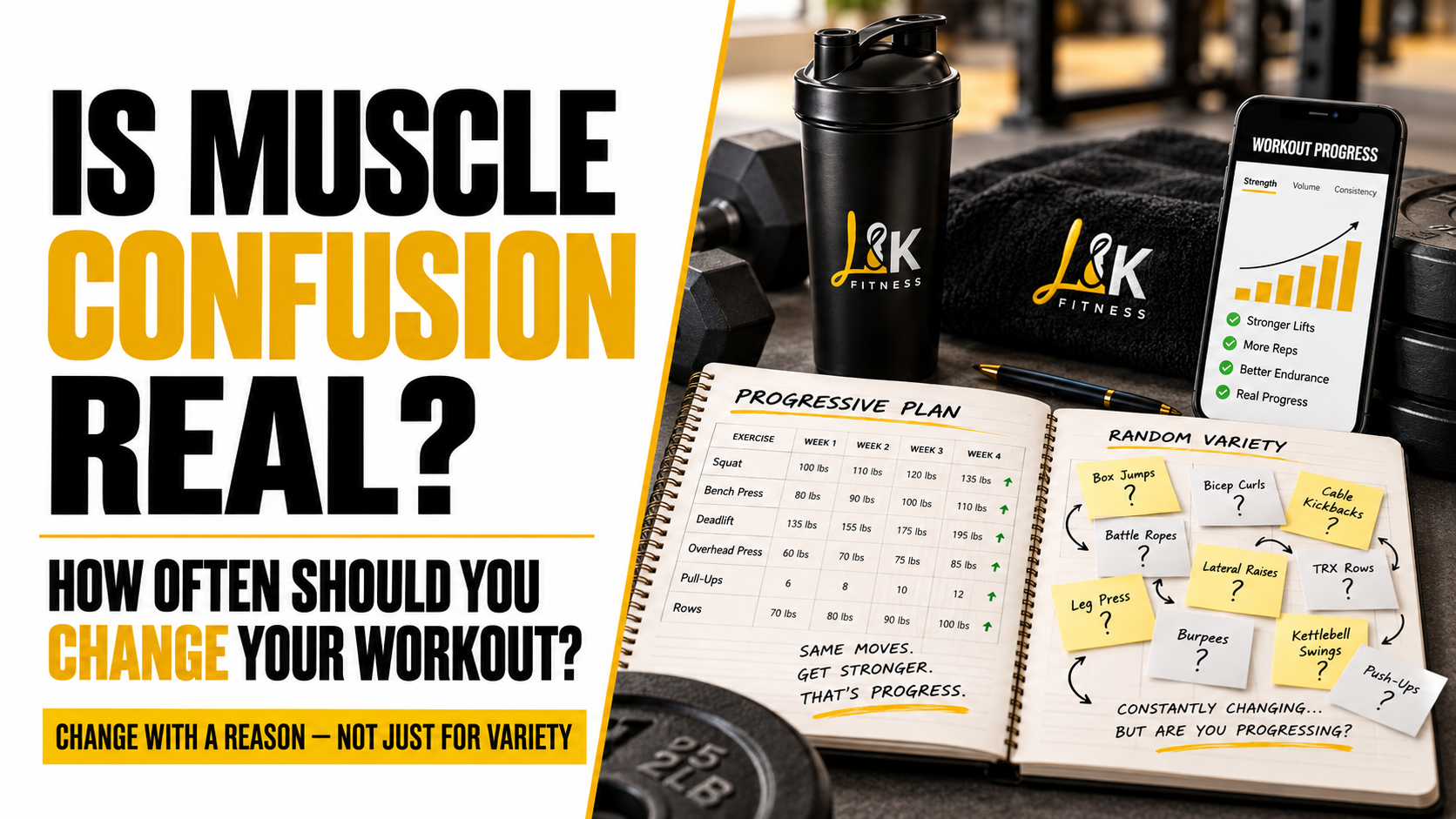
How Often to Change Exercises – and When You Should Keep Doing What’s Working
You’ve been doing the same workout for six weeks.
Same squats.
Same presses.
Same rows.
Same damn Bulgarian split squats you’ve grown to hate with the fiery passion of a thousand suns.
So naturally, you start wondering:
Shouldn’t I be doing something different by now?
Maybe.
But there’s another question we’d ask first:
Are you still getting better at the things you’re already doing?
Because somewhere along the way, fitness culture convinced us that a good program should constantly entertain us.
New exercises.
New circuits.
New challenges.
Something to keep the muscles “guessing.”
Except your muscles aren’t sitting around thinking:
“Geez, bench press again?”
Your muscles don’t know that you’re bored.
They respond to the demands you place on them.
And sometimes changing something that’s still working is a great way to interrupt your own progress.
Before You Change an Exercise, Ask 3 Questions
1. Am I still progressing?
Are you adding reps?
Adding weight?
Improving your technique?
Using a better range of motion?
Performing more quality work?
If performance is still moving forward, the exercise is probably still doing its job.
2. Can I perform it comfortably?
We don’t mean:
“Does this suck?”
Some exercises suck.
We mean:
Does this movement consistently cause actual pain or aggravate something?
If it does, there may be a better option.
3. Does it still serve my goal?
Exercises are tools.
If the tool still fits the job, there’s no prize for replacing it just because you’ve used it for six weeks.
If your answers are:
Yes. Yes. Yes.
You probably don’t need to change it yet.
Progress the Demand – Not Necessarily the Exercise
Progressive overload simply means gradually asking your body to do more over time.
That might mean:
8 reps becomes 10.
50 pounds becomes 55.
Your range of motion improves.
Your execution gets better.
You add another productive set.
Or you perform the same work with greater control.
Progress the demand – not necessarily the exercise.
Research backs this up.
One study in resistance-trained adults compared increasing repetitions with increasing load over eight weeks.
Both strategies produced muscular adaptations. (1)
So if:
185 × 8
becomes
185 × 10…
you progressed.
The load didn’t need to change.
The exercise didn’t need to change.
The demand did.
Your Muscles Don’t Need Confusion. You Need Consistency.
This is where the old idea of “muscle confusion” gets things backward.
Your muscles don’t need to be surprised.
They need to be challenged.
And repetition gives us something extremely useful:
Data.
Last month you used 50-pound dumbbells for 9 reps.
Now you’re getting 12.
Cool.
Something improved.
But if you do dumbbell bench this week…
Machine press next week…
Cable press the week after…
Then incline dumbbells because TikTok has informed you that your upper chest is apparently an emergency…
You’ve created plenty of variety.
But have you actually gotten stronger?
Harder to tell.
A systematic review looking specifically at exercise variation found that planned variation may benefit strength and regional muscle development, while excessive or random variation may actually compromise muscular adaptations. (2)
So variation isn’t bad.
It’s a tool.
Randomness isn’t a training principle.
So… Should You Change It?
Here’s the simple version.
Change It If:
It consistently hurts.
Actual pain – not “my quads are burning and I hate this.”
You’ve genuinely plateaued.
Not one shitty Tuesday.
If performance has stalled for a meaningful period despite consistent effort, adequate recovery, and enough time to actually judge the program, changing something may help.
Your goal changed.
Your training should serve the goal.
Your life changed.
Different schedule.
Different equipment.
Injury.
Travel.
Fewer available training days.
Life happens. Your program should be able to adapt.
You need a different stimulus.
Maybe we want to emphasize another muscle, address a weakness, manage fatigue differently or develop another physical quality.
You hate it enough that adherence is suffering.
This counts.
The theoretically “optimal” exercise isn’t very optimal if you consistently half-ass it or stop showing up because you despise it.
Don’t Change Just Because:
– You saw something cooler on Instagram.
– You aren’t getting as sore anymore.
– The workout doesn’t destroy you like it did during Week One.
– You’ve been doing it for six weeks.
– You think your muscles have “figured it out.”
– You’re bored – but still progressing.
Boring and ineffective are not the same thing.
“But My Body Adapted. Doesn’t That Mean It Stopped Working?”
No.
Adaptation is literally what we’re trying to create.
You got stronger?
Adaptation.
You built muscle?
Adaptation.
Your technique improved?
Adaptation.
You can perform more work than you could six weeks ago?
Adaptation.
Your body adapting to training isn’t the problem.
That’s the entire point.
The answer to adaptation isn’t automatically replacing the exercise.
Often, the answer is increasing the demand.
A 2026 randomized trial helps illustrate this nicely.
Both groups performed resistance training and both experienced muscle growth.
But the group that progressively increased its training load experienced greater triceps growth over eight weeks. (3)
Same basic movement.
Increasing demand.
Greater adaptation.
That’s progressive training.
Change With a Reason
We’re not suggesting you perform the exact same workout until the sun burns out.
Training should evolve.
Exercises change.
Volume changes.
Rep ranges change.
Goals change.
People change.
But change something because you have a reason.
Not because:
– The calendar flipped over.
– You saw a cool exercise online.
– Your muscles supposedly figured out your secret plan.
And not because you’ve decided six weeks is the expiration date on a squat.
Sometimes productive training is surprisingly boring.
Show up.
Do the movements.
Execute them better.
Add a rep.
Add some weight.
Get stronger.
Then do it again.
Your workout doesn’t always need to be new.
It needs to keep giving you somewhere to go.
Not Sure If Your Program Is Actually Progressing?
Knowing that your training should progress is easy.
Knowing what to progress, when to progress it, when to hold steady, and when something actually needs to change is where programming gets more complicated.
That’s one of the advantages of having someone else looking at the data with you.
At Lock & Key Fitness, we don’t change workouts just to make them look different.
We watch performance.
We listen to feedback.
We adjust when there’s a reason.
The goal isn’t to keep your workouts interesting enough to entertain you.
It’s to keep your training moving you toward something.
If you’re already training but aren’t sure whether your current program is actually moving you forward, that’s exactly the kind of problem we help people solve.