
When Eating Less Stops Working
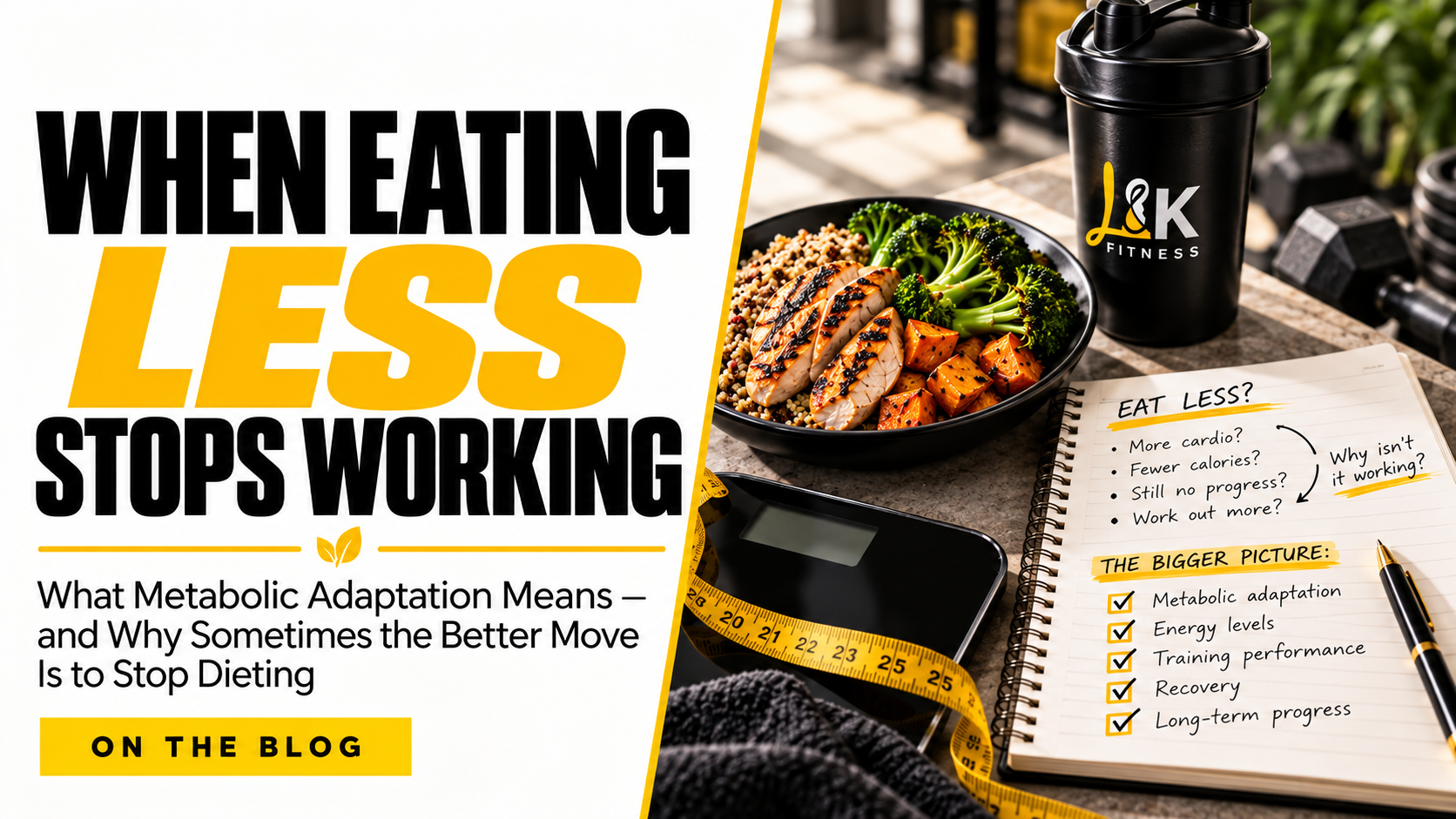
What Metabolic Adaptation Means – and Why Sometimes the Better Move Is to Stop Dieting
Someone comes to us and says:
“I’m eating 1,200–1,300 calories a day. I work out all the time. I’m trying to lose weight, but nothing is happening.”
The obvious answer might be:
You need a bigger calorie deficit.
Okay.
From where?
Drop her to 1,100 calories?
Add more cardio?
Tell her to get another 5,000 steps?
At some point, “eat less, move more” stops being useful coaching advice.
Not because energy balance stopped existing.
Not because her metabolism is “broken.”
But because the human body adapts.
And sometimes the smartest thing you can do for future fat loss is stop trying to lose fat for a while.
“Eat Less, Move More” Isn’t Wrong. It’s Incomplete.
Fat loss requires an energy deficit.
That part hasn’t changed.
But energy expenditure isn’t a fixed number.
As you lose weight, there’s less body to maintain and move around.
You may unconsciously move less.
Resting energy expenditure can decrease.
Exercise may require less energy.
Hunger can increase.
And prolonged calorie restriction can produce an additional reduction in energy expenditure beyond what we’d predict from weight loss alone.
That’s called metabolic adaptation, or adaptive thermogenesis.
Research shows that it’s real – but also highly variable and generally smaller in higher-quality studies than some dramatic claims online would suggest. It may also diminish after a period of weight stabilization and neutral energy balance. (1)
So no:
Your metabolism isn’t “broken.”
Your body adapted to what you repeatedly asked it to do.
When Cutting More Stops Making Sense
Now let’s go back to our hypothetical client.
She’s eating around 1,250 calories.
Training frequently.
Weight loss has stalled.
She’s exhausted.
Her workouts are getting worse.
She’s constantly hungry and thinking about food.
Maybe she’s sleeping poorly.
Maybe she’s moving less without realizing it.
The answer shouldn’t automatically be:
“Try harder.”
Those symptoms don’t prove metabolic adaptation. We’d still want to look at actual food intake and tracking accuracy, activity, body-weight trends, adherence, and how long the plateau has really lasted.
But if the bigger picture points toward prolonged, aggressive restriction, we should ask a different question:
Should weight loss even be the goal right now?
For active women especially, things like menstrual disturbances, recurrent injuries and impaired recovery can also be signs that energy availability is too low.
Those aren’t signals to cut another 100 calories.
They’re reasons to look at the bigger picture.
Sometimes the Next Fat-Loss Phase Starts by NOT Dieting
If someone is already eating very little, continuing to cut gives us less and less room to work.
1,300 becomes 1,200.
1,200 becomes 1,100.
Then what?
Instead, it may be time to spend a period eating closer to maintenance.
This is also where you’ll often hear the term “reverse diet.”
A reverse diet generally means gradually increasing calories after prolonged restriction until someone reaches a more sustainable intake.
It’s a strategy we may use in coaching.
But let’s clear something up:
Reverse dieting isn’t a magical metabolism-repair protocol.
We don’t have strong evidence that slowly adding calories back uniquely “fixes” metabolism compared with appropriately returning someone toward maintenance.
A gradual approach can still be useful.
It provides structure.
It allows us to monitor body weight, hunger, training and recovery.
And for someone who has spent months afraid to eat more, it may make the transition easier to manage.
The priorities become:
Get adequately fueled.
Improve training and recovery.
Reduce diet fatigue.
Establish a sustainable maintenance intake.
Create somewhere productive to go next.
Research on planned diet breaks supports the broader idea that continuous restriction isn’t our only option. A systematic review and meta-analysis of randomized trials found similar body-composition changes between continuous dieting and approaches incorporating break periods, while the reduction in resting metabolic rate was smaller with diet breaks. (2)
And yes – the scale may initially move when calories increase.
More carbohydrates can mean more stored glycogen and associated water. More food also means more material moving through your digestive system.
An increase on the scale does not automatically mean you suddenly regained a bunch of body fat.
Meanwhile, we’re watching what else changes:
Energy.
Training performance.
Recovery.
Hunger.
Sleep.
Daily activity.
If fat loss becomes an appropriate goal again later, we’re no longer staring at 1,200 calories wondering what the hell we’re supposed to remove next.
We’ve built some runway.
The Goal Isn’t Always to Lose More Weight
Sometimes someone needs a calorie deficit.
Sometimes their tracking needs work.
Sometimes they need more activity.
Sometimes they need more patience.
And sometimes they’ve been dieting for so long that another calorie reduction is the last thing we’d recommend.
Knowing the difference is where individualized coaching matters.
Good coaching shouldn’t be:
Scale stopped moving → remove food.
It should mean looking at the person in front of us.
Their intake.
Their history.
Their activity.
Their training.
Their recovery.
And deciding what actually makes sense right now.
If you’ve been dieting harder and harder while getting less and less in return, the answer isn’t automatically another calorie cut.
You may not need a harder diet.
You may need to become someone who’s ready to diet again.
If this sounds like the approach you’ve been looking for, tap below to learn more about the Lock & Key Collective