
Is Your Workout Actually Working?
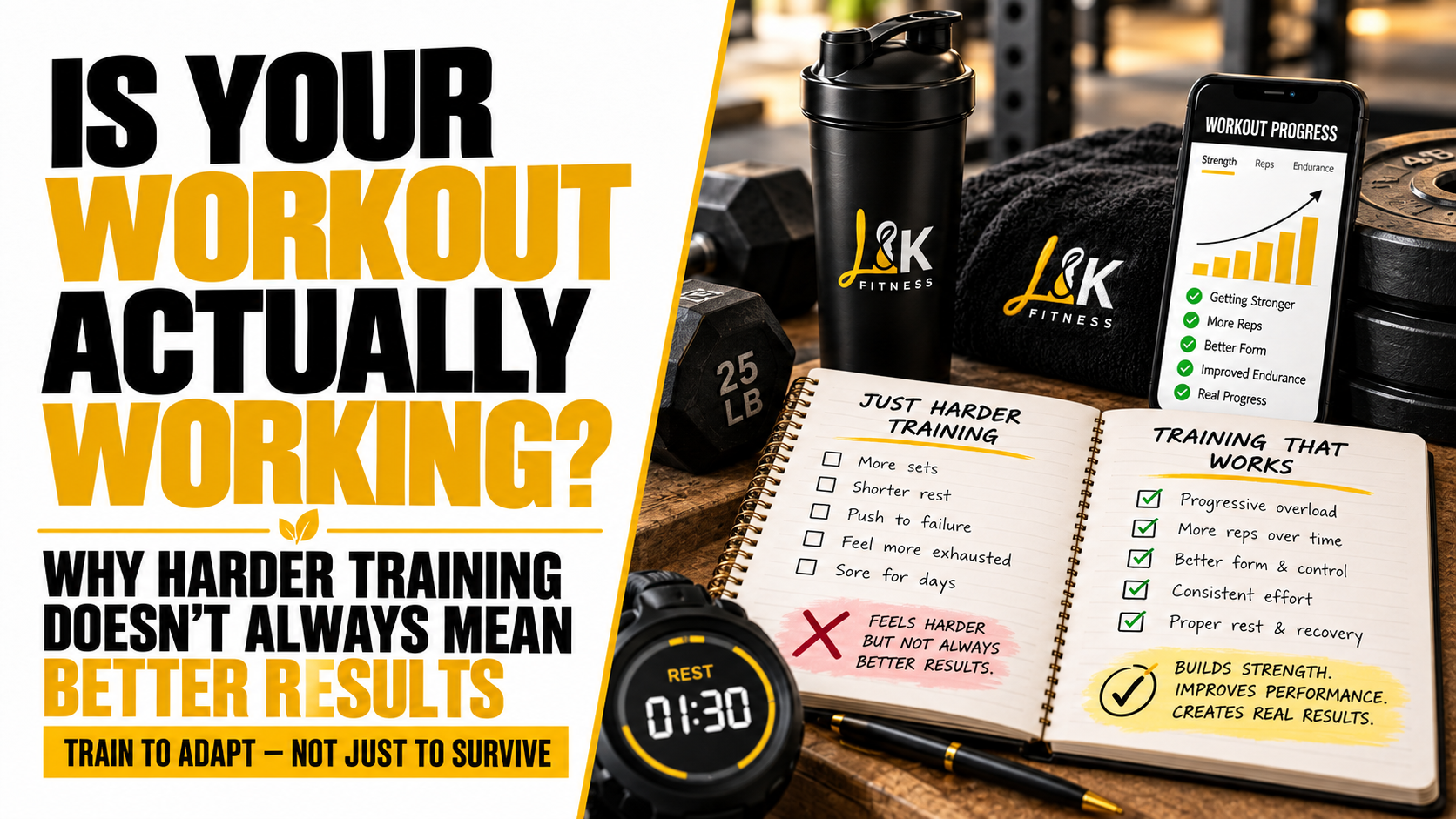
Why Harder Training Doesn’t Always Mean Better Results
You finished your workout drenched in sweat.
Your heart rate was through the roof.
Your legs are shaking.
Walking down the stairs feels like a legitimate safety concern.
Great workout… right?
Maybe.
Here’s a better question:
What did you actually get better at?
There’s an important difference between a workout being hard and a workout being productive.
You can superset everything, keep your rest periods short, take every set until you’re seeing dead relatives, and leave the gym completely wrecked.
That’ll certainly make training difficult.
But difficulty alone isn’t what we’re after.
The goal of training isn’t to prove how much suffering you can tolerate.
It’s to give your body a reason to adapt.
Hard Work Still Matters
This isn’t an argument for easy workouts.
If you’re trying to build muscle and consistently ending sets with five or six good reps left in you, you’re probably leaving results on the table.
Research suggests that muscle growth tends to increase as sets are performed closer to muscular failure. But reaching absolute failure on every set doesn’t appear necessary. (1)
That distinction matters.
You need effort. You don’t necessarily need annihilation.
For many working sets, getting reasonably close to the point where another good rep would be difficult gives us plenty of stimulus without creating fatigue just for the sake of fatigue.
Hard training is useful.
Getting destroyed is not the goal.
Fatigue Can Fool You
A workout that leaves you gasping for air feels productive.
Short rests feel harder.
Supersets feel harder.
Dropsets feel harder.
Being incredibly sore the next morning definitely feels like you accomplished something.
But none of those things automatically tell us whether the workout was effective.
Soreness is a great example.
Muscle soreness and damage can happen after productive training, particularly when you introduce something new. But muscle damage itself doesn’t appear to be what drives or enhance muscle growth. (4)
So waking up thinking:
“I can barely sit on the toilet. Yesterday must have been an amazing leg day.”
…isn’t exactly a scientific measurement of training quality.
Sometimes soreness just means you did something your body wasn’t accustomed to.
Stop Racing Your Rest Periods
Another easy way to make a workout harder is to barely rest.
Finish a set.
Thirty seconds.
GO.
Your heart rate stays high. Everything burns. You’re sweating your ass off.
But if you’re still winded when the next set starts, you may be limiting how well you can actually perform it.
A 2024 systematic review found that muscle growth can occur across a wide range of rest periods, but there may be a small advantage to resting longer than 60 seconds between sets. The evidence becomes much less clear that increasingly longer rests provide additional muscle-growth benefits beyond that. (2)
That doesn’t mean every set of curls requires a five-minute intermission.
It means:
Rest long enough to perform the next set well.
Sometimes standing around doing absolutely nothing is part of a productive workout.
Enjoy it.
Progressive Overload Is the Scorecard
So what should we actually be watching?
Performance.
Are you getting stronger?
Can you perform more reps with the same weight?
Can you use the same weight with better execution?
Are you controlling the movement better?
Can you train through a greater range of motion?
Eventually, can you add load?
That’s progressive overload—and adding weight isn’t the only way to accomplish it.
In a study of resistance-trained adults, researchers compared progressing by adding weight with progressing by adding repetitions. Both approaches produced muscular adaptations over the eight-week training period. (3)
So if last month you did:
100 pounds × 8
and now you’re doing:
100 pounds × 12
with good technique and a similar level of effort?
You got better.
That’s the kind of evidence we’re looking for.
Ask Better Questions About Your Workouts
Instead of walking out of the gym asking:
“Was that hard enough?”
Ask:
Did I perform the movements well?
Did I train close enough to failure where appropriate?
Did I maintain or improve my performance?
Am I progressing these movements over time?
Can I recover well enough to come back and do it again?
Those questions tell us considerably more than how sweaty your shirt is.
Because the goal isn’t to win today’s workout.
It’s to become stronger six months from now.
Train to Adapt, Not Just to Survive
There’s nothing wrong with enjoying a brutal workout.
Sometimes finishing a nasty set and wondering what series of poor life decisions led you there is part of why we love training.
But don’t confuse the experience of working hard with proof that your program is working.
A good training program gives you somewhere to go.
It lets you repeat movements long enough to measure progress.
It gives you enough rest to perform well.
It asks for enough effort to create a meaningful stimulus.
And over time, something improves.
More reps.
More weight.
Better execution.
More muscle.
More strength.
That’s what we’re looking for.
Not simply:
“That sucked.”
At Lock & Key Fitness, we don’t program workouts just to make people tired. We track performance, adjust training based on feedback, and give clients a clear path for progression.
Because anyone can make a workout harder.
The trick is making it productive.