
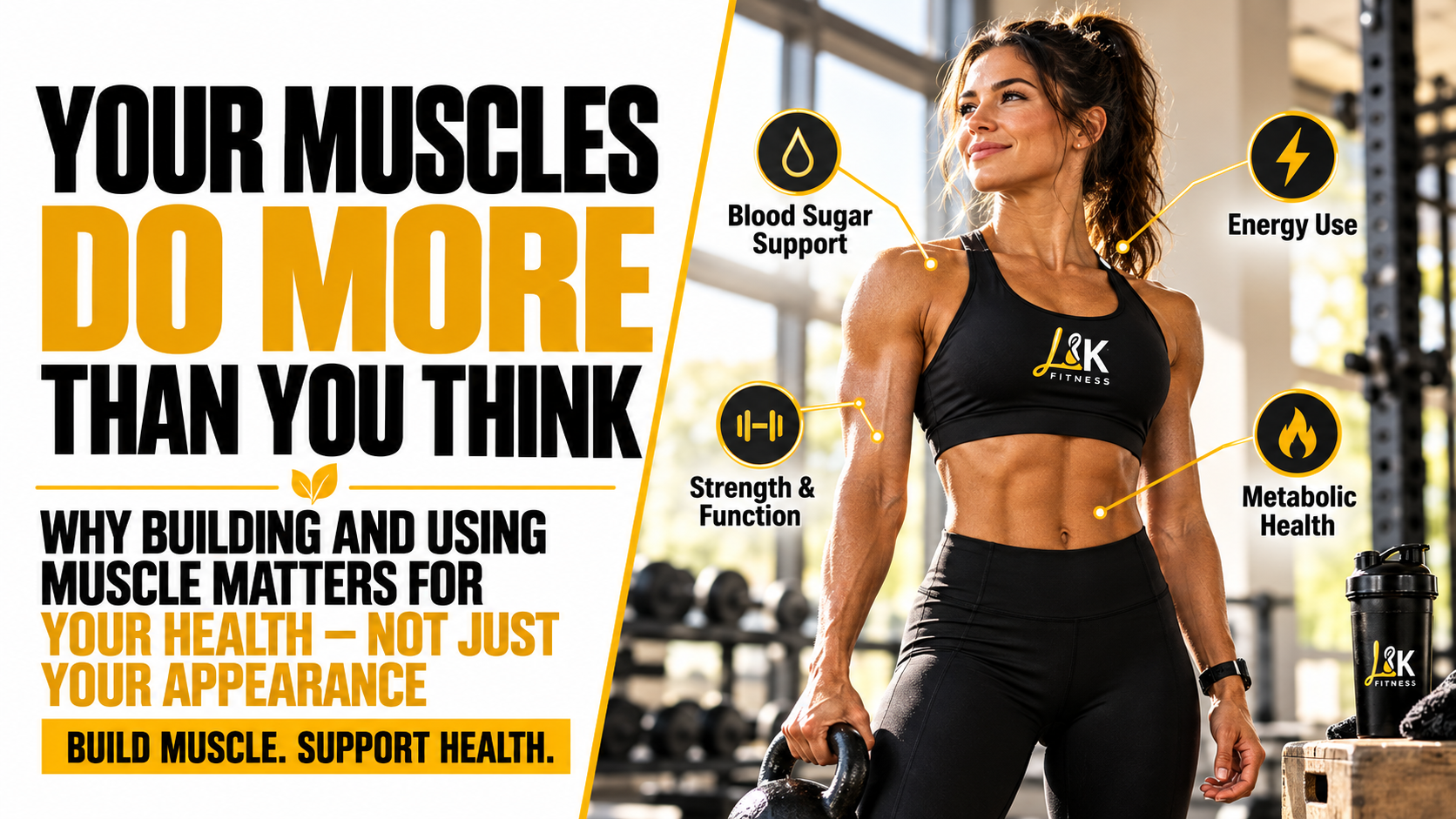
Why Building and Using Muscle Matters for More Than Just Your Appearance
When most people think about building muscle, they think about how it looks.
Bigger arms. Broader shoulders. More defined legs. Maybe finally filling out that T-shirt the way you want.
And there’s absolutely nothing wrong with wanting those things.
But here’s something that doesn’t get nearly enough attention:
Your muscles do a hell of a lot more than make you look good or help you lift heavy things.
They’re involved in regulating your blood sugar, managing energy, and even communicating with other parts of your body.
That’s right. Your muscles are doing a whole lot more than moving your skeleton around.
And some of the most important benefits of training are things you’ll never actually see in the mirror.
Let’s get into it.
Your Muscles Help Manage Your Blood Sugar
Every time you eat carbohydrates, your body breaks down the digestible ones into sugars that enter your bloodstream.
One of the biggest destinations for that sugar?
Your muscles.
In fact, skeletal muscle accounts for roughly 70–80% of the glucose your body takes up in response to insulin under certain conditions.
That’s a pretty significant job.
Normally, insulin helps signal your muscle cells to pull sugar out of your bloodstream, where it can be used for energy or stored for later.
But here’s where things get interesting.
When your muscles contract during exercise, they can also take up glucose without relying on that same insulin signal.
In other words, moving your body gives your muscles another way to access fuel.
Exercise can also make your muscles more responsive to insulin afterward, helping your body manage blood sugar more effectively.
This is one reason regular exercise is such a valuable tool for metabolic health.
Your muscles aren’t just burning energy. They’re helping your body manage it.
More Muscle Doesn’t Automatically Mean a Faster Metabolism
You’ve probably heard someone claim that building muscle turns your body into a calorie-burning furnace.
Well…not exactly.
Muscle tissue does require energy to maintain itself, and having more of it can increase the number of calories you burn at rest.
But the effect is considerably smaller than some fitness influencers would have you believe.
Adding five pounds of muscle doesn’t suddenly mean you can eat an extra thousand calories every day.
Sorry. We wish it worked that way, too.
Here’s what’s more interesting:
You don’t necessarily have to build enormous amounts of muscle to improve your metabolic health.
A 2024 review of resistance-training research found that improvements in blood sugar regulation weren’t consistently explained by how much additional muscle people gained.
That suggests some of the benefits come from the act of training and the changes your muscles undergo in response – not simply from having more muscle tissue.
Your body can become better at handling glucose even when visible muscle growth is modest.
Building muscle is valuable. But regularly using the muscle you already have is valuable, too.
Your Muscles Communicate With the Rest of Your Body
This is where the science gets especially fascinating.
Most people think of muscles as mechanical structures.
They contract. They produce force. They help us move.
But your muscles also release chemical messengers that can influence what’s happening elsewhere in your body.
Scientists call some of these messengers myokines.
And while the name sounds complicated, the basic concept isn’t.
When you exercise, your muscles don’t just perform work. They also send signals.
Those signals can influence processes related to inflammation, energy use, and how different tissues communicate with one another.
Researchers are still working out exactly which signals are responsible for specific health benefits, so there’s plenty we don’t fully understand yet.
And no, doing three sets of squats doesn’t release some magical anti-aging substance that instantly fixes everything.
Although that would be pretty convenient.
The important point is that your muscles aren’t isolated from the rest of your body.
They’re actively involved in a much larger system that helps keep you functioning optimally.
Why Strength Training Matters – Even If You Don’t Want to Get Bigger
Not everyone wants to look like a bodybuilder.
And not everyone needs to.
But almost everyone benefits from being stronger, maintaining healthy muscle tissue, and keeping that muscle capable of doing its job.
For example, a 2024 analysis of 46 randomized controlled trials involving 2,130 adults with Type 2 diabetes found that resistance training improved both fasting blood sugar and HbA1c.
HbA1c is a measurement that helps show what someone’s average blood sugar has looked like over roughly the previous two to three months.
That’s meaningful evidence that resistance training can improve important markers of metabolic health – not just muscle size.
And you don’t need to overcomplicate things to get started.
A sensible resistance-training program that challenges your major muscle groups at least twice per week is a great starting point for most adults.
Combine that with regular cardiovascular activity, adequate nutrition, and sufficient recovery.
Then keep doing it.
You might not feel your muscles becoming more responsive to insulin or notice the chemical signals they’re sending throughout your body.
But that doesn’t mean those changes aren’t happening.
Some of the most important benefits of exercise happen behind the scenes.
Train for More Than What You See in the Mirror
There’s nothing wrong with wanting bigger muscles, a leaner physique, or a new personal record.
Those are perfectly legitimate reasons to train.
But they’re far from the only ones.
Your muscles help regulate blood sugar, manage energy, and communicate with other parts of your body.
And keeping them strong and functional is an investment that extends well beyond the gym.
You’re not just building a better-looking body.
You’re building a body that’s better equipped to function.
And that’s a pretty damn good reason to keep training.
At Lock & Key Fitness, we help people build strength, improve their health, and develop training and nutrition habits they can maintain for the long haul.
Because the goal isn’t simply to look better for a few months.
It’s to build a healthier, more capable body for years to come.
Sources
A Comprehensive View of Muscle Glucose Uptake: Regulation by Insulin, Contractile Activity, and Exercise. Physiological Reviews, 2025. DOI: 10.1152/physrev.00033.2024.
Resistance Training, Skeletal Muscle Hypertrophy, and Glucose Homeostasis: How Related Are They? A Systematic Review and Meta-Analysis. Applied Physiology, Nutrition, and Metabolism, 2024. DOI: 10.1139/apnm-2024-0128.
The Impact of Resistance Exercise Training on Glycemic Control Among Adults With Type 2 Diabetes: A Systematic Review and Meta-Analysis of Randomized Controlled Trials. 2024. PMID: 38623887.
Exercise as a Tool to Mitigate Metabolic Disease. American Journal of Physiology–Cell Physiology, 2024. DOI: 10.1152/ajpcell.00144.2024.
Exercise Training Mode Effects on Myokine Expression in Healthy Adults: A Systematic Review With Meta-Analysis. Journal of Sport and Health Science, 2024.