
Are You Actually Recovering? The Recovery Hierarchy Nobody Talks About
Here’s What Really Helps Your Body Recover From Training
Recovery has gotten complicated.
Cold plunges. Saunas. Massage guns. Compression boots. Foam rollers. Mobility routines. Red light therapy. HRV monitors. Sleep trackers. Supplements.
Somewhere along the way, recovery became its own hobby.
Meanwhile, you slept five and a half hours, haven’t eaten enough all week, your protein intake is anybody’s guess, and you’ve trained six days straight.
But hey – the massage gun is fully charged.
There’s nothing inherently wrong with recovery tools. Plenty of them can be useful.
But we’ve started confusing recovery modalities with recovery itself.
And those aren’t necessarily the same thing.
What Are We Actually Recovering From?
Training is stress.
That’s part of the point.
A productive workout gives your body a reason to adapt. It creates fatigue and temporarily disrupts your body’s normal state.
Then comes the important part:
Training → Recovery → Adaptation → Training Again
The goal isn’t to eliminate every trace of fatigue, soreness, or discomfort the moment your workout ends.
The goal is to give your body the resources and time it needs to adapt to what you just asked it to do.
And most of those resources aren’t particularly sexy.
The Big Rocks Are Boring
Before worrying about whether you need a sauna in your basement, let’s make sure the basics are covered.
1. Sleep
This one’s hard to outsmart.
In one controlled study, healthy young men restricted to four hours in bed for five consecutive nights experienced lower rates of myofibrillar protein synthesis – the process involved in repairing and remodeling muscle tissue – compared with normal sleep conditions. (1)
That doesn’t mean one crappy night kills your gains.
It does show that sleep is part of the physiological recovery process—not simply something that makes you feel less tired.
2. Eat Enough
Your body needs resources to recover.
That doesn’t mean everyone needs to eat in a calorie surplus. You can absolutely recover while getting leaner in a deficit.
But there’s a difference between intentionally managing calories and chronically underfueling the work you’re asking your body to perform.
You can’t continually ask for more output while refusing to provide enough input.
3. Get Your Protein
Yes, we’re talking about protein again.
No, we’re not sorry.
Protein provides the amino acids your body uses to repair and build tissue. And when it comes to resistance training, consistently getting enough total daily protein matters considerably more than obsessing over some magical 30-minute anabolic window. (2)
Hit the big target before worrying about the tiny one.
4. Don’t Forget the Carbs
Protein gets all the glory.
Carbohydrates do a lot of the grunt work.
Training uses muscle glycogen, and carbohydrates help replenish it. (3)
Exactly how much you need depends on how much and how frequently you train. But if performance and recovery matter, fueling the work matters too.
5. Make Sure Your Program Isn’t the Problem
Sometimes you don’t have a recovery problem.
You have a programming problem.
More sets.
More exercises.
More training days.
More cardio.
More everything.
Eventually, the workload you’re accumulating can exceed what you’re currently capable of recovering from.
And there’s no massage gun attachment for that.
Sometimes the solution isn’t another recovery intervention.
It’s better management of training volume, frequency, and fatigue.
Feeling Better and Adapting Better Aren’t the Same Thing
This distinction matters.
A massage might make you feel fantastic.
Foam rolling might make you feel looser.
Cold water may reduce soreness.
A sauna might help you relax.
Those are legitimate benefits.
Feeling better matters. If something reduces discomfort, helps you relax, or makes you more willing to train again, there can absolutely be value in that.
But we need to separate two questions:
“Does this make me feel recovered?”
and
“Does this improve my adaptation to training?”
Because the answer isn’t always the same.
Feeling better is valuable. But feeling better and adapting better aren’t automatically the same thing.
Which brings us to everybody’s favorite giant tub of freezing water.
The Cold-Plunge Paradox
Cold plunges aren’t bullshit.
But they aren’t magic either.
Cold-water immersion can be useful when reducing soreness or restoring performance relatively quickly is the priority. (4)
The interesting part comes when long-term muscle growth is the goal.
A 2024 systematic review and meta-analysis found that regularly using cold-water immersion immediately after resistance training may modestly reduce hypertrophy adaptations. (5)
Importantly, the researchers also cautioned that the quality of the available evidence was only fair to poor. (6)
So this isn’t exactly a case for the Cold Plunge Police.
Other research has suggested a potentially small negative effect on strength adaptations as well, although the results aren’t completely uniform across different protocols.
So no:
Your cold plunge isn’t “killing your gains.”
But if maximizing muscle growth is your primary goal, routinely jumping into freezing water immediately after every lifting session isn’t something you need to prioritize either.
And that’s really the bigger lesson.
Recovery tools aren’t inherently good or bad. Their usefulness depends on what you’re trying to accomplish.
So… Are Recovery Tools Worthless?
Nope.
Wrong lesson.
Instead, ask:
What problem am I trying to solve?
Soreness?
Range of motion?
Relaxation?
Sleep?
Getting ready to perform again tomorrow?
Long-term strength or muscle growth?
Those are different problems.
And they may require different solutions.
A recovery tool should have a job.
Otherwise, we’re just collecting expensive fitness toys.
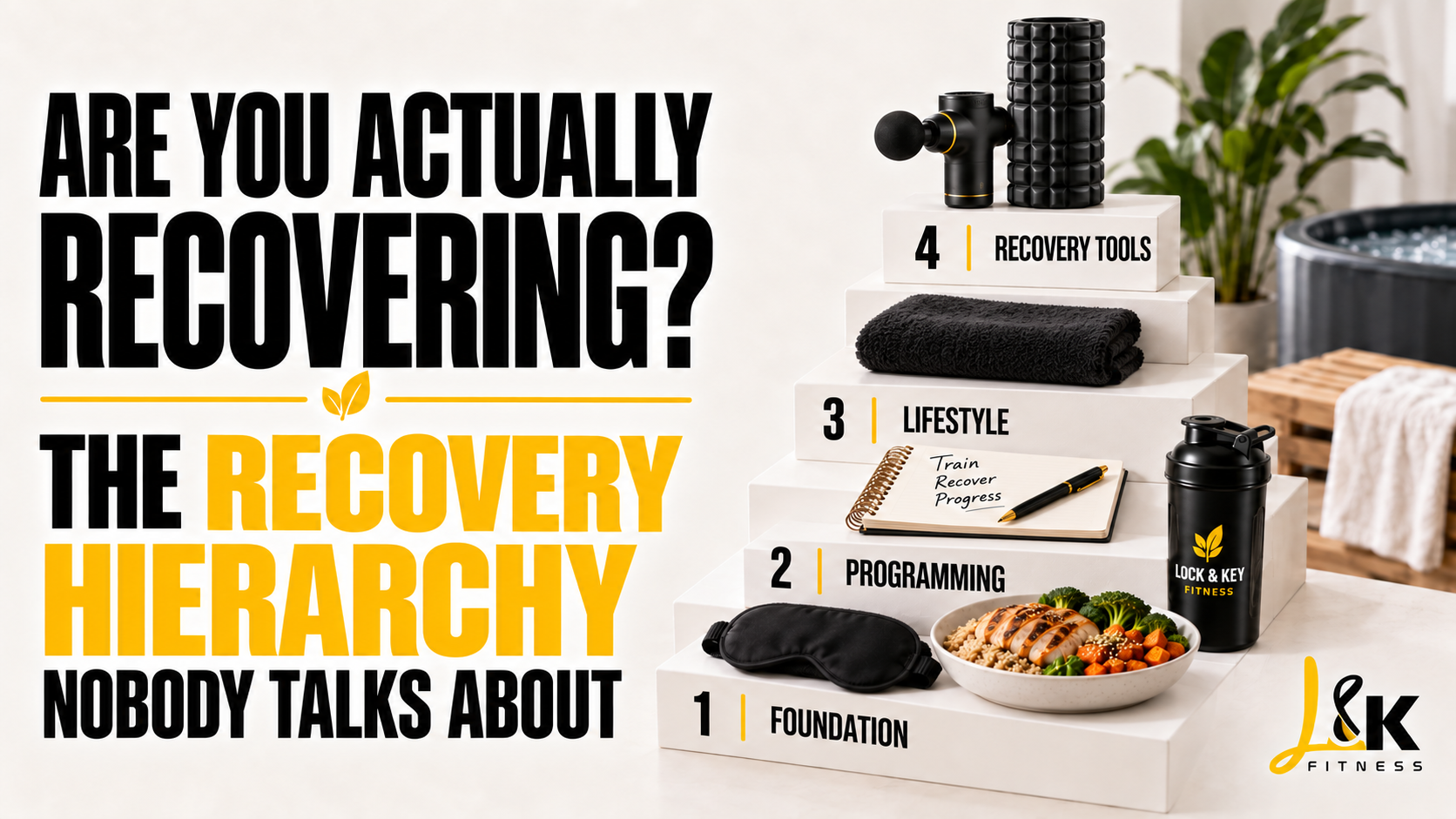
The Lock & Key Recovery Hierarchy
Before spending another dollar trying to optimize recovery, work your way from the bottom up.
LEVEL 1 – FOUNDATION
Sleep + Nutrition + Fueling
Are you sleeping enough?
Eating appropriately for your goals?
Getting enough protein?
Fueling the training you’re asking your body to perform?
↓
LEVEL 2 – PROGRAMMING
Training + Fatigue Management
Is your workload appropriate?
Are you allowing adequate recovery between demanding sessions?
Are you consistently accumulating more fatigue than you can recover from?
↓
LEVEL 3 – LIFESTYLE
Stress + Life Outside the Gym
How physically demanding is the rest of your day?
How high is your overall stress load?
Are you actually giving yourself opportunities to slow down?
↓
LEVEL 4 – RECOVERY TOOLS
The Extras
Saunas.
Cold plunges.
Massage.
Foam rolling.
Compression.
Supplements.
And whatever recovery gadget Instagram convinces us we desperately need next.
Level 4 isn’t worthless.
But Level 4 shouldn’t be expected to rescue Levels 1–3.
That $400 recovery gadget has absolutely no idea you went to bed at 1:30 a.m.
Before You Optimize Recovery, Master It
You don’t need to throw away your massage gun.
You don’t need to sell your sauna.
And we’re certainly not coming to your house to confiscate your cold plunge.
If you enjoy those things, use them.
Just don’t confuse doing more recovery activities with recovering better.
Before recovery became an industry, your body already had a pretty damn effective recovery system.
Most of the time, it needs you to provide the basics:
Sleep.
Eat.
Get your protein.
Fuel your training.
Manage your workload.
Rest when appropriate.
Then worry about optimizing around the edges.
Because the basics aren’t particularly exciting.
They’re not new.
They’re not proprietary.
And nobody can sell you a $900 Bluetooth-enabled version of eight hours of sleep.
But boring works.
🔐 Want More Strategies That Actually Work?
If you’re tired of fitness advice that makes training, nutrition, and recovery feel far more complicated than they need to be, join our email list.
We’ll send practical, evidence-based strategies straight to your inbox to help you train effectively, recover well, and keep making progress – without chasing every new fitness fad that wanders across your feed.
Join the email list and let’s make the basics work for you. 🔑
Sources:
Saner NJ, et al. The effect of sleep restriction, with or without high-intensity interval exercise, on myofibrillar protein synthesis in healthy young men.https://pubmed.ncbi.nlm.nih.gov/32078168/
Schoenfeld BJ, Aragon AA, Krieger JW. The effect of protein timing on muscle strength and hypertrophy: a meta-analysis.https://pubmed.ncbi.nlm.nih.gov/24299050/
Burke LM, Hawley JA, Wong SHS, Jeukendrup AE. Carbohydrates for training and competition.https://doi.org/10.1080/02640414.2011.585473
Bleakley C, et al. Cold-water immersion (cryotherapy) for preventing and treating muscle soreness after exercise.https://pubmed.ncbi.nlm.nih.gov/22336838/
Piñero A, et al. Throwing cold water on muscle growth: A systematic review with meta-analysis of the effects of postexercise cold-water immersion on resistance training-induced hypertrophy.https://doi.org/10.1002/ejsc.12074
Moore E, et al. The effects of regular cold-water immersion use on training-induced changes in strength and endurance performance: A systematic review with meta-analysis.https://doi.org/10.1007/s40279-020-01362-0