
Waiting for the Perfect Time to Start Working Out? Why You May Never Feel “Ready”
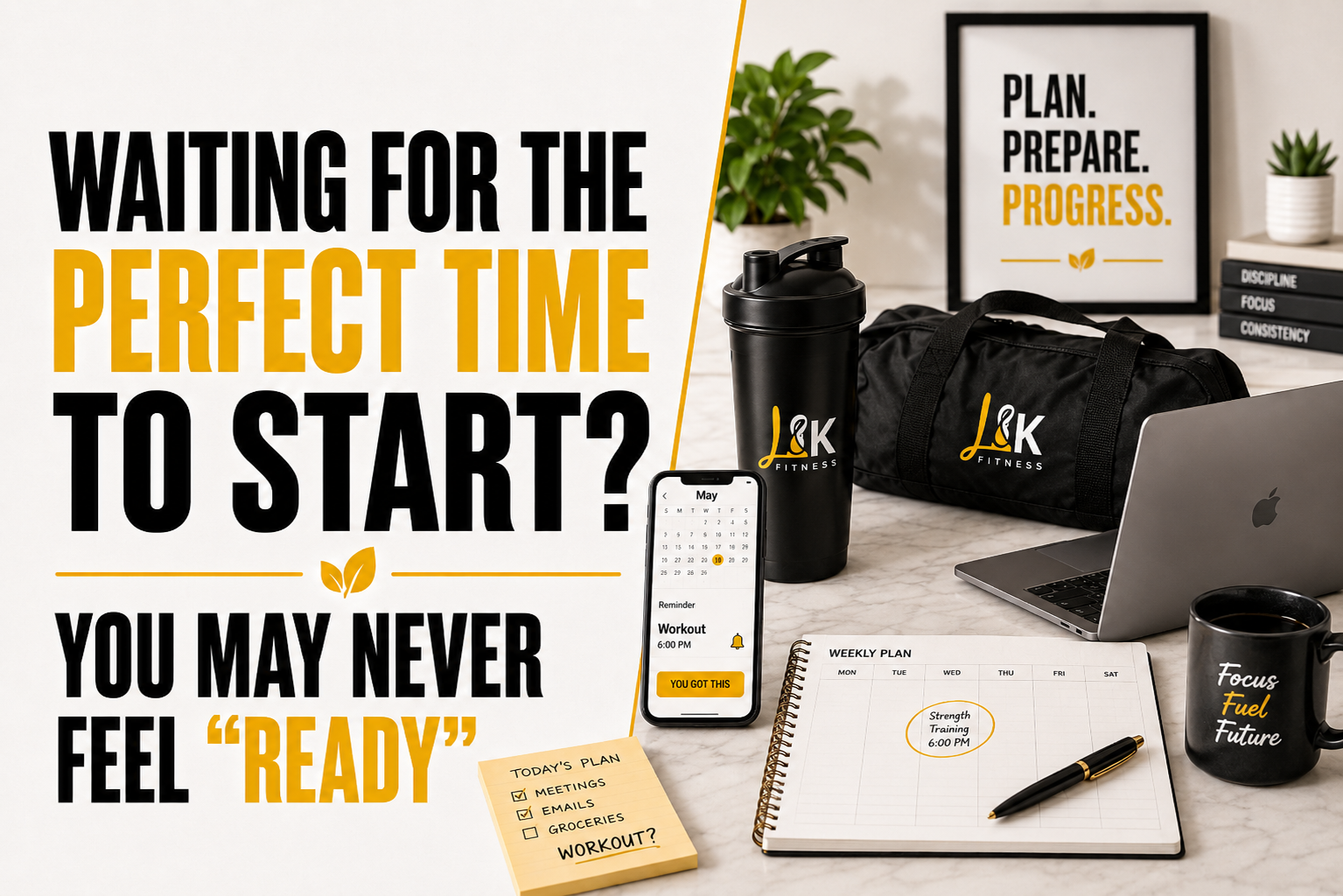
There’s a strange thing people sometimes do before asking for help with their fitness.
They try to get better at fitness first.
“I want to lose a few pounds before I join.”
“I need to get consistent in the gym first.”
“Let me clean up my eating first.”
“Work is insane right now. Once things settle down, I’ll start.”
“I have a trip coming up. Maybe after that.”
We understand the instinct.
Nobody particularly enjoys showing up somewhere feeling like they don’t have their shit together.
And if you’ve started and stopped a dozen times before, there may be an even bigger question hiding underneath all of it:
What if I try again and fail again?
That’s a legitimate concern.
But there’s a problem with waiting until you feel completely ready:
The things you’re waiting to accomplish before getting support are often the exact things the support is going to help you accomplish.
Wanting to Change and Feeling Ready Aren’t the Same Thing
Most people struggling with their fitness don’t need to be convinced that exercise is good for them.
They know.
They probably know they should eat more protein.
Get more sleep.
Lift weights.
Walk more.
Eat some damn vegetables.
We have more fitness information available to us than we could possibly consume.
But knowing – and even genuinely wanting to change – doesn’t guarantee that change happens.
A 2023 systematic review and meta-analysis involving 29,600 participants found a substantial intention-behavior gap in physical activity: among people who intended to be active, roughly 48% did not successfully translate that intention into the corresponding behavior.
That’s a pretty important distinction.
There can be a huge gap between:
“I want this.”
and
“I’m consistently doing the things required to get there.”
You can genuinely want something and still feel nervous about beginning.
You can be excited and uncertain simultaneously.
And you can believe something would be good for you without feeling 100% confident that you’ll succeed.
Readiness usually doesn’t arrive before action.
Action is what begins creating readiness.
The Perfect Time Is a Moving Target
“I’ll start when work slows down.”
Then work slows down…
but there’s a vacation coming.
After vacation, the kids have something going on.
Then there’s a big project.
Then somebody gets sick.
Then the holidays are coming.
Then January is crazy.
Then…
You get the idea.
Those obstacles aren’t imaginary.
They’re life.
The mistake is assuming you’ll eventually reach some magical stretch where none of them exist.
For most adults, the calendar changes.
The obstacles change.
The responsibilities change.
But there’s usually something.
So instead of asking:
“When will my life finally be perfect for this?”
Ask:
“How can I make this work within the life I have?”
That’s a problem we can actually solve.
You Don’t Need to Remove the Obstacles Before You Start
This is where behavioral research gets useful.
Researchers often distinguish between action planning – deciding when, where, and how you’ll perform a behavior – and coping planning, which anticipates barriers and identifies ways of dealing with them.
A 2022 systematic review and meta-analysis examined 41 randomized controlled trials involving 5,439 participants. Across the 35 trials included in the quantitative analysis, planning interventions produced a significant small-to-moderate improvement in physical activity compared with control conditions.
In normal-person language:
Having a concrete plan can close some of the distance between wanting to be active and actually being active.
Importantly, planning doesn’t require eliminating uncertainty.
You’re not waiting until nothing can go wrong.
You’re figuring out what you’re going to do – and, in some planning approaches, how you’ll respond when something gets in the way.
That’s a much more realistic approach to fitness.
You don’t need a perfect schedule.
You need a plan capable of surviving an imperfect one.
Stop Trying to Get in Shape Before You Get Help Getting in Shape
We see versions of this all the time.
Someone is interested in coaching but thinks:
“I should probably get back into the gym first.”
Why?
That’s what we’re here for.
“I want to lose ten pounds first.”
Again…
That’s what we’re here for.
“I need to get my eating under control.”
You can probably see where this is going.
It’s a little like cleaning your house before the housekeeper arrives because you don’t want the housekeeper knowing your house needed cleaning.
We get it.
There’s vulnerability involved in letting somebody see where you’re actually starting.
But you don’t need to impress your coach on Day One.
Your starting point is information.
Maybe you’re an experienced lifter who needs better programming.
Maybe you haven’t trained consistently in five years.
Maybe your nutrition is great Monday through Thursday and turns into the Wild West every weekend.
Maybe you don’t know what a macro is and would strongly prefer to keep it that way.
We start there.
The purpose of coaching isn’t to congratulate you for arriving with everything figured out.
It’s to help you figure out what comes next.
“But What If I Fail Again?”
This one deserves more attention.
Because if you’ve tried before and things didn’t work out, hesitation isn’t necessarily procrastination.
It can be self-protection.
Maybe you’ve joined gyms.
Bought programs.
Tracked food.
Lost weight and gained it back.
Started January convinced this time would be different.
And eventually, something fell apart.
So now another opportunity comes along and you’re not really wondering:
“Could this work?”
You’re wondering:
“Can I trust myself to stick with it this time?”
We’re not going to insult you with a motivational-poster answer.
Nobody can promise you’ll never struggle again.
And joining a coaching program doesn’t magically remove the parts where you still have to do the work.
But here’s what a previous attempt doesn’t prove:
That you’re incapable of succeeding.
A previous attempt gives you information.
Where did things break down?
Did you have a plan that actually fit your life?
Did you know what to do when the scale stopped moving?
What happened when work got crazy?
Did you have support when motivation disappeared?
Was your approach so restrictive that eventually you couldn’t wait to escape from it?
Did one bad week become an excuse to abandon the entire thing?
Those answers matter.
Because if you keep responding to every failed attempt with:
“Next time I’ll just try harder.”
…you’re ignoring everything the previous attempt could’ve taught you.
Sometimes the answer isn’t more effort.
Sometimes it’s better programming.
Better expectations.
Better communication.
Better support.
A better environment.
A better system.
Failure isn’t useful because failure is somehow wonderful.
Failure is useful when you stop treating it like a verdict and start treating it like data.
Confidence Comes After Evidence
There’s another reason waiting until you “feel confident” doesn’t work particularly well.
Confidence needs evidence.
You become more confident in the gym after you’ve trained for a while.
You become more confident navigating nutrition after you’ve successfully handled a few restaurants, vacations, weekends, and stressful days.
You become more confident that one bad week won’t derail you after you’ve recovered from a few bad weeks.
You start trusting yourself because you’ve accumulated evidence that you can follow through.
So the sequence isn’t:
Confidence → Action → Success
It’s:
Action → Evidence → Confidence
You don’t need to feel like a completely different person before you begin.
You start becoming that person by repeatedly doing the things that person does.
So What Do You Actually Need to Be “Ready”?
Less than you might think.
You don’t need:
– Perfect motivation.
– An empty calendar.
– A flawless relationship with food.
– Years of gym experience.
– A refrigerator full of color-coded meal-prep containers.
– Unwavering confidence that you’ll never struggle.
You need:
A reason that matters to you.
A willingness to participate.
Honesty about where you’re starting.
And enough willingness to take the next step without knowing exactly how every step after it will go.
The rest?
That’s what the process is for.
You Aren’t Supposed to Arrive Coached
If you’re considering joining the Lock & Key Collective, this is important.
You don’t need to become consistent before joining.
Building consistency is part of the coaching.
You don’t need to understand exactly how to structure your nutrition.
Learning how to make nutrition work for your goals and your life is part of the coaching.
You don’t need to know exactly how you should train.
That’s literally why we write your training program.
And you certainly don’t need to remove every obstacle from your life before September 1.
They’re not going anywhere.
Instead, we help you learn how to navigate them.
Because good coaching shouldn’t create a temporary bubble where fitness becomes easy.
It should help you develop the skills to keep going when it isn’t.
September 1 Is Coming Either Way
September 1 is going to arrive whether you feel ready or not.
Then October 1.
Then January 1.
Time doesn’t particularly care whether we’ve made up our minds.
So if you’ve been reading these blogs…
Opening the Dispatch every week…
Looking at the Collective…
Thinking about reaching out…
And telling yourself:
“Maybe. I’m just not sure I’m ready yet.”
Ask yourself something different:
What exactly am I waiting to become ready for?
You don’t have to show up September 1 with everything figured out.
You don’t have to prove anything to us first.
And you don’t need certainty about what the next six months will look like.
You need to decide whether where you’re trying to go matters enough to take the next step.
The next Lock & Key Collective training phase begins September 1.
If you’ve been circling the decision, this is the week to talk to us.
Not because September 1 is magically the perfect time.
Because you don’t need the perfect time to start.
You need a starting point.
And this one is right in front of you.