
Too Busy to Work Out? Why You Need to Protect Your Training Time
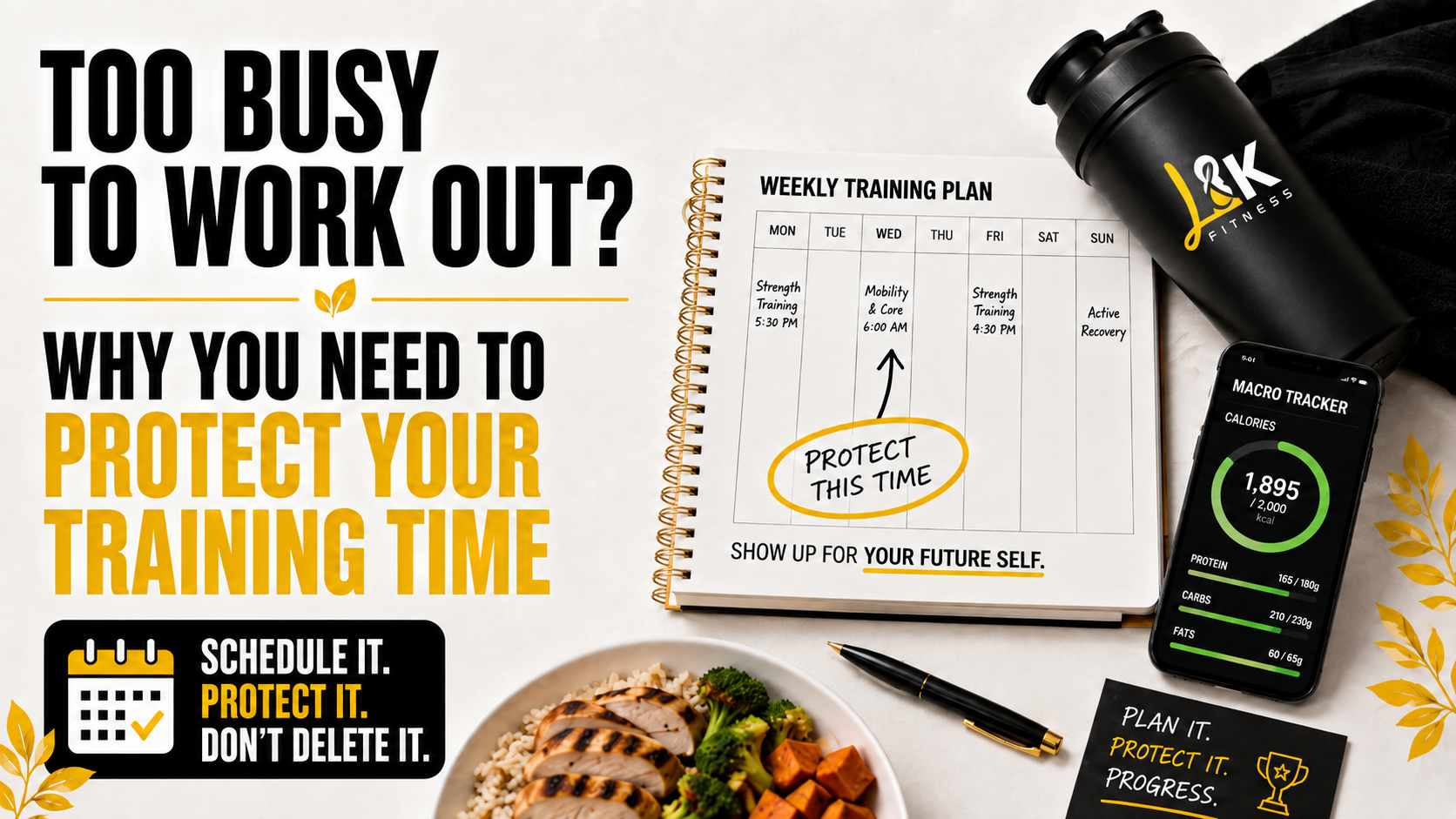
If your workout only happens when nothing else gets in the way, your workout isn’t going to happen very often.
Because something will always get in the way.
There’s always another email.
Another project at work.
Another errand.
Another appointment.
Another thing around the house that needs attention.
And if your approach to exercise is:
“I’ll work out when I have time…”
Eventually, all of those other things will take the time.
That’s why one of the most important skills for staying consistent with exercise isn’t finding more motivation.
It’s learning to protect your training time.
You’re Probably Not Going to “Find” Time to Work Out
We hear some version of this all the time:
“I’ve just been too busy to work out.”
And sometimes that’s completely understandable.
There are seasons when work gets crazy. Kids have activities. Someone gets sick. You’re traveling. Your normal routine gets blown apart.
Being busy is real.
But if you’re waiting for life to become less busy before you start exercising consistently, you might be waiting a very long time.
Most adults don’t suddenly stumble into an extra four hours every week with nothing competing for them.
You have to decide where that time is going to come from.
That doesn’t mean fitness needs to become the most important thing in your life.
It probably shouldn’t be.
But if your health matters to you, training needs a place in your schedule before everything else gets an opportunity to take that place.
Treat Your Workouts Like Appointments
Think about an important appointment.
If you have a dentist appointment Tuesday at 3:00, you don’t wake up Tuesday morning and think:
“I’ll see if I have time for the dentist today.”
It’s already on the calendar.
You work around it.
Training should work similarly.
Instead of telling yourself:
“I’ll work out three times this week.”
Decide when.
Monday: 5:30 p.m.
Wednesday: 6:00 a.m.
Friday: 4:30 p.m.
Now you’ve taken an intention and turned it into a plan.
And there’s research supporting that distinction.
Researchers call this strategy implementation intentions.
Instead of only deciding what you’re going to do, you decide ahead of time when, where, and how you’re going to do it.
A 2018 systematic review and meta-analysis examined 13 randomized controlled trials using implementation-intention strategies to increase physical activity. When those strategies were reinforced, they improved physical activity compared with control conditions. (1)
That’s the difference between:
“I’m going to exercise more.”
and:
“After work Monday, I’m driving directly to the gym and training from 5:30–6:30.”
You made the decision before Monday arrived.
And that’s important.
Because Monday is going to give you plenty of reasons to make a different one.
Scheduling Creates Commitment. Flexibility Protects Compliance.
Putting workouts on the calendar is only half the equation.
Because no matter how carefully you plan…
Life is still going to happen.
Meetings get scheduled.
Kids get sick.
Work runs late.
Sometimes your Tuesday workout genuinely cannot happen Tuesday.
Fine.
Move the appointment. Don’t automatically delete it.
Maybe Tuesday becomes Wednesday.
Maybe your 60-minute workout becomes 35 minutes.
Maybe you use the hotel gym instead of your normal gym.
That’s adaptation.
This idea was important enough to us that we intentionally built it into how our members use the Lock & Key Fitness App.
Our coaches build the training program, but our clients can move their own scheduled workouts based on what’s actually happening in their lives.
Because we can write an excellent four-day program for you.
What we can’t do is predict exactly what your Thursday will look like three weeks from now.
So if Thursday blows up?
Move the workout.
No frantic message to your coach.
No waiting for us to rearrange your calendar.
No feeling like you “messed up” the program.
Adjust the schedule and keep moving.
It makes things smoother for the client and the coach while removing one more obstacle between having a plan and actually following it.
Because structure and flexibility aren’t opposites.
The best training systems have both.
Stop Giving Everything Else First Access to Your Time
Sometimes when we say:
“I didn’t have time to work out…”
what we really mean is:
Something else was allowed to take that time.
Sometimes that something is legitimately more important.
Your kid gets sick?
Take care of your kid.
An emergency happens?
Handle it.
But other times, work ran 45 minutes longer because we never established a stopping point.
We decided the laundry needed to happen immediately.
Someone asked for a favor that could’ve waited.
We picked up our phone for “a few minutes.”
Suddenly the training window disappeared.
That doesn’t make you lazy.
But it does reveal something:
If there is no boundary around your training time, almost anything can replace it.
Protecting that time sometimes requires saying:
“Not right now.”
The dishes can wait.
That email can be answered after training.
Unless something genuinely deserves to outrank the commitment you made to yourself, your workout doesn’t automatically need to be the first thing sacrificed.
Have a Plan B Before You Need Plan B
Consistency is usually determined by what happens when Plan A disappears.
That’s why we encourage people to decide ahead of time what their backup options look like.
Plan A: Complete the full workout as scheduled.
Plan B: Move the workout or shorten the session and prioritize your most important exercises.
Plan C: Do what you realistically can with the time and equipment available.
Plan C isn’t magically as effective as Plan A.
That’s not the point.
The point is:
Something going wrong with Plan A doesn’t automatically require Plan Nothing.
A shortened workout still counts.
A rescheduled workout still counts.
An imperfect training week still counts.
Consistency isn’t the absence of disruption.
It’s your ability to keep returning to the plan when disruption happens.
Being Busy Isn’t the Problem
There’s a version of fitness culture that loves saying:
“Everyone has the same 24 hours.”
Technically?
Sure.
Practically?
That’s a pretty useless observation.
People have different jobs, families, responsibilities, resources, and amounts of control over their schedules.
We’re not pretending otherwise.
The goal isn’t to shame busy people into exercising.
It’s to recognize that being busy and being consistent are not mutually exclusive.
Research on implementation intentions has also found that personalized planning around when, where, and how someone will exercise can improve people’s confidence in their ability to remain active when they’re dealing with time constraints.
That’s the skill we’re trying to develop.
Not creating a life where nothing gets in the way.
Creating a system that can withstand the fact that something eventually will.
Build Your Training Schedule Around Your Actual Life
Don’t build a fitness routine for the person you wish you were.
Build one for the person you actually are.
Maybe you’d love to train at 5:00 a.m., but you’ve tried repeatedly and sleep through your alarm.
Useful information.
Maybe Friday evening workouts constantly collide with family activities.
Also useful information.
Maybe your work schedule changes every week.
Then your training schedule may need to change every week too.
Look at your actual schedule.
Identify the windows you have the most control over.
Put your training there.
Then protect those windows as much as realistically possible.
Before each week begins:
1. Choose your training days.
2. Choose your training times.
3. Identify the most likely conflicts.
4. Decide what Plan B looks like.
You’re not trying to predict everything that could go wrong.
You’re removing the need to make every decision in the moment.
You Don’t Need More Time. You Need Protected Time.
There’s always going to be another thing you could be doing.
Another task.
Another obligation.
Another reason today isn’t ideal.
That’s life.
The goal isn’t to eliminate those things.
It’s to stop allowing every other demand on your time to automatically outrank your health.
Schedule it.
Protect it.
Move it when necessary.
Don’t automatically delete it.
Because the people who stay consistent aren’t necessarily the people with the emptiest calendars.
They’re the people who learn how to keep training while their calendars are full.
Being busy isn’t the problem.
Having no plan for what happens when you get busy is the problem.
Want a Training Plan That Can Actually Survive Real Life?
This is exactly the type of problem we work through inside the Lock & Key Collective.
We don’t expect you to organize your entire life around fitness.
We build training, nutrition, accountability, and habit systems that work within the life you already have.
Your workouts are programmed for you.
You can schedule them around your availability.
And when life changes – as it inevitably will – you have both the flexibility to adjust and coaches helping you make sure an interrupted week doesn’t become an abandoned month.
Because great coaching isn’t about creating a perfect plan and expecting life to cooperate.
It’s about building a strong enough system to keep you moving when life doesn’t.
Enrollment for the Lock & Key Collective is open now, and our next training phase begins September 1st.
If you’re ready to level up your fitness with a training routine you can sustain, tap below to learn more about joining our community.