
Why Hitting Your Macros Isn’t Enough: Build Meals, Not Numbers
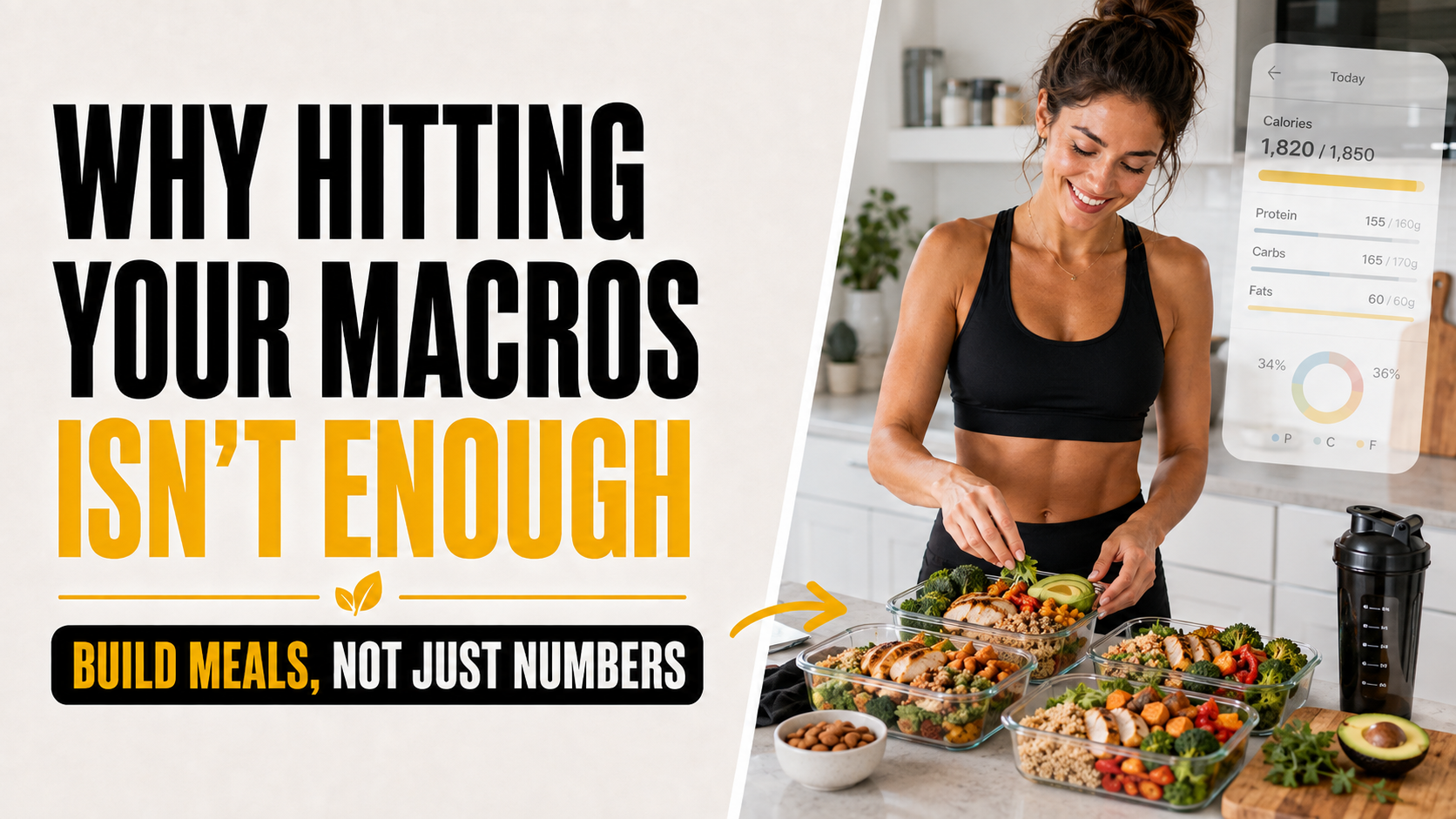
“Macros tell you how much to eat. Meals determine how well you live.”
One of the first nutrition skills we teach our clients is how to track their macros.
It can be an incredibly valuable educational tool.
Tracking protein, carbohydrates, fats, and calories teaches portion awareness. It helps you understand where your energy comes from, creates accountability, and removes much of the guesswork surrounding nutrition.
For many people, it’s the first time they’ve truly seen how their everyday food choices add up.
But something interesting often happens after a while.
People become incredibly good at hitting their numbers without necessarily becoming better at eating.
That might sound strange. After all, aren’t those the same thing?
Not exactly.
We’ve seen clients hit every target while eating a couple of protein bars, two shakes, a handful of crackers, and whatever foods happened to “fit” before bed.
Technically, their macros were perfect.
But did that day of eating support steady energy, comfortable digestion, satisfying meals, productive workouts, and habits they’d want to maintain for the next twenty years?
Probably not.
That’s where the next level of nutrition begins.
Not by abandoning macro tracking, but by graduating beyond it.
Macro Tracking Is a Tool – Not the Destination
Let’s be clear: we’re not anti-macro tracking.
Far from it.
Tracking can teach awareness, flexibility, and accountability. It has helped countless people lose weight, build muscle, improve their performance, and finally understand what they’re eating.
The problem isn’t the tool.
The problem is confusing the tool with the goal.
Instead of asking:
“What would make a balanced, satisfying meal?”
Many people begin asking:
“How do I fit another 22 grams of protein into my day?”
Those are two very different questions.
One helps you learn how to nourish yourself.
The other teaches you how to solve a math problem.
Being able to hit your numbers is useful. Being able to build meals that naturally bring you close to those numbers is even more useful.
Eventually, the goal should shift.
Not away from macros.
Toward meals.
Your Body Doesn’t Eat Macros. It Eats Meals.
Think about one of your favorite meals.
Maybe it’s grilled chicken, roasted potatoes, and asparagus.
Maybe it’s tacos with lean ground beef, rice, salsa, and avocado.
Maybe it’s Greek yogurt with berries, granola, and almonds.
You probably don’t remember that meal because it contained exactly 42 grams of protein.
You remember it because it tasted good. It satisfied you. It gave you energy and became something you could reliably return to.
That’s how healthy eating becomes sustainable.
You stop spending the entire day asking, “What’s left in my macros?” and start building meals that naturally move you toward your goals.
A solid meal gives your nutrition structure without demanding perfection. It can provide protein, fiber, carbohydrates, fats, vitamins, minerals, and enough total energy in one dependable package.
Over time, those meals become part of your routine.
And routine matters for more than convenience.
Regular Meals Support More Stable Energy and Appetite
One of the most common complaints we hear from people who technically “hit their macros” is that they still feel tired, hungry, or preoccupied with food.
Sometimes the issue is total calorie intake.
Other times, those calories are simply distributed in a way that makes the day harder than it needs to be.
Someone may eat very little all morning, grab small snacks through the afternoon, train underfueled, and then spend the evening trying to make up hundreds of calories before bed.
The daily total might look correct in the app, but the experience of getting there feels terrible.
Meals containing protein, fiber-rich carbohydrates, fats, and fruits or vegetables generally provide more staying power than grazing on small convenience foods all day.
Research on protein shows that, in the hours following a meal, higher protein intake can increase fullness and satiety while influencing appetite-related hormones such as GLP-1, CCK, and ghrelin. The long-term effects are more complex, but protein’s short-term satiating effect is well supported. [1]
Fiber contributes in several ways. Depending on the type, it can add bulk, slow digestion, support fermentation by gut microbes, and help extend feelings of fullness. Different fibers behave differently, so this isn’t as simple as “more fiber always means slower digestion,” but regularly eating fiber-rich whole foods supports both appetite regulation and gastrointestinal health. [2]
In practical terms, a complete meal buys you time.
Time when you aren’t distracted by hunger.
Time when you aren’t negotiating with the pantry.
Time to focus on your work, your family, your training, or whatever else matters that day.
Your Digestive System Benefits From Consistency Too
Digestion isn’t controlled by a perfect eating schedule, and you don’t need to eat at precisely 12:03 every afternoon to have a healthy gut.
Still, regular meals can make healthy digestion easier to support.
When meals consistently include fruits, vegetables, whole grains, legumes, nuts, seeds, and other fiber-rich foods, you’re more likely to consume the mixture of fiber and nutrients needed to support normal bowel function and the gut microbiome.
By contrast, a day built mostly around bars, shakes, crackers, and highly processed snacks may technically contain enough calories and protein while providing very little fiber, food volume, or variety.
Meal regularity itself may also matter. In a large observational study of adults, more regular meal patterns were associated with lower odds and reduced severity of irritable bowel syndrome. That does not prove irregular eating causes digestive disorders, but it supports the idea that chaotic meal patterns may be connected to gastrointestinal symptoms for some people. [3]
Regular meals also make it easier to notice patterns.
You can see whether a certain food leaves you bloated, whether your pre-workout meal sits well, or whether you consistently become ravenous after a lunch that is too small.
When food intake is completely random, it becomes much harder to identify what is actually helping or bothering you.
Meal Timing Helps Support Your Natural Rhythms
Your body operates according to roughly 24-hour circadian rhythms.
These rhythms help coordinate sleep and wakefulness, body temperature, digestion, appetite, hormone release, and the way your body handles nutrients at different times of day.
Light is the strongest signal for the brain’s central clock, but eating also acts as an important timing cue for organs and tissues involved in metabolism.
Research on chrononutrition suggests that eating patterns that repeatedly conflict with the body’s biological day – such as consuming a large proportion of food late at night – may contribute to circadian misalignment and less favorable metabolic responses. The research is still developing, and individual schedules and chronotypes matter, but our bodies do not process food identically at every hour of the day. [4]
This doesn’t mean everyone needs to follow the same eating schedule.
It means your body generally appreciates some predictability.
Eating your first meal at 7:00 one morning, noon the next day, and 3:00 p.m. the day after – then eating half your calories immediately before bed – creates a very different physiological pattern than eating a few reasonably balanced meals during your waking hours.
In a small controlled study, women following an irregular meal pattern experienced less favorable changes in insulin sensitivity, dietary thermogenesis, and fasting lipids than they did while following a regular pattern. One study cannot settle the entire question, but it demonstrates that identical-looking calories can produce different responses depending on how consistently they are consumed. [5]
Your meals don’t need to happen at the exact same minute every day.
A general rhythm is enough:
Breakfast around the same part of the morning.
Lunch before you’re desperately hungry.
A meal or snack that supports your training.
Dinner early enough that you aren’t cramming half your intake into the final hour before bed.
Structure should make your life easier – not turn eating into another rigid set of rules.
Consistent Fueling Supports Hormonal Health
Nutrition conversations often use vague promises about “balancing your hormones.”
That phrase is frequently oversimplified.
Regular meals do not magically fix every hormonal issue. However, consistently providing enough total energy, protein, carbohydrates, fats, vitamins, and minerals gives your endocrine system the resources it needs to function normally.
This is especially important for active people.
When energy intake repeatedly falls too far below the demands of exercise and daily life, the body may begin conserving resources. Low energy availability has been associated with changes in thyroid hormones, reproductive hormones, appetite regulation, bone metabolism, cortisol, and other endocrine functions in both female and male athletes. [6]
And it may not be enough to simply “catch up” at the end of the day.
In one study of female endurance athletes, those with menstrual dysfunction spent more hours of the day in a significant energy deficit than athletes with regular menstrual cycles, despite having similar estimated 24-hour energy availability. More time spent in an energy deficit was also associated with lower estradiol and resting metabolic rate markers and higher cortisol. [7]
That doesn’t mean every person needs to eat every two hours.
It means that asking your body to train, recover, work, think, and regulate itself while receiving very little food for most of the day may have consequences that a perfectly calculated late-night meal cannot fully erase.
Regular meals help distribute energy more appropriately across the hours when you’re asking your body to perform.
Food Noise Isn’t Always a Willpower Problem
“Food noise” is the constant mental chatter surrounding food.
What should I eat next?
Can I fit this into my macros?
Why am I hungry again?
Should I save my calories for later?
Many people assume this preoccupation means they lack discipline.
Sometimes it simply means their meals aren’t doing their job.
When your day is organized around satisfying meals, food can become something you enjoy and then move on from.
When your nutrition depends on constant grazing and improvising, you’re repeatedly forced to make another decision.
That gets mentally exhausting.
One of the simplest ways to create more mental space is to develop three or four dependable meals that leave you fueled, satisfied, and ready to continue with your day.
They do not have to be fancy.
In fact, boringly reliable meals are often nutrition superheroes wearing sweatpants.
Snacks Should Support Meals – Not Replace Them
We’re not against snacks.
Snacks absolutely have a place.
A Greek yogurt between lunch and dinner.
Fruit and a protein shake around training.
Cottage cheese before bed.
Cheese, crackers, and fruit when you need something portable.
Those can all be useful choices.
But there’s an important difference between using snacks strategically and building your entire diet out of snack foods.
Your meals should provide the foundation.
Snacks fill the smaller gaps.
When snacks become the foundation, it is often harder to eat enough fruits and vegetables, reach an appropriate fiber intake, feel physically satisfied, and create habits that work without constant tracking.
Fuel the Work You’re Asking Your Body to Do
Nutrition isn’t only about losing weight.
It supports performance, recovery, health, and your ability to participate fully in your life.
Suppose you’re asking your body to strength train three or four days per week, walk 8,000 to 10,000 steps, recover from challenging workouts, build muscle, sleep well, and still have energy for your career and family.
That requires more than random snacks assembled to satisfy an app.
It requires enough total fuel, distributed in a way that supports what you’re doing.
A quality protein source provides the amino acids needed for repair and adaptation.
Carbohydrates help fuel demanding training and replenish glycogen.
Dietary fats support cellular health, nutrient absorption, and the production of many signaling molecules.
Fruits, vegetables, whole grains, and other minimally processed foods provide fiber, vitamins, minerals, and compounds that contribute to long-term health.
No individual meal has to contain everything.
The pattern matters more than perfection.
But when most of your meals contain a useful combination of these foods, hitting your macros becomes far easier—and your macros begin representing a better overall diet.
What We Coach Inside the Lock & Key Collective
Inside the Lock & Key Collective, our goal isn’t to create people who need to track macros forever.
We want our members to understand nutrition well enough that, eventually, they may not have to.
Macro tracking is the classroom.
Meal building is graduation.
We teach our members how to build balanced plates without overthinking every bite.
How to fuel training instead of merely surviving it.
How to distribute food across the day so they have energy when they need it.
How to recognize whether a meal needs more protein, produce, carbohydrates, fats, or overall substance.
How to create a small rotation of dependable meals that work during normal workweeks – and flexible strategies for vacations, holidays, travel, and busier seasons.
Because sustainable nutrition isn’t created by hitting one perfect set of numbers.
It’s built through ordinary meals, repeated often enough to become an ordinary part of your life.
Final Thoughts
Keep tracking your macros if they’re helping you.
They can be one of the best educational tools available.
But don’t stop there.
Learn how to build meals before obsessing over individual numbers.
Use snacks to support your meals rather than replace them.
Create a general rhythm without turning your schedule into a prison.
Fuel your training throughout the day instead of trying to repair an underfueled day at bedtime.
Macros can help you reach a goal.
Meals help you build the energy, health, and routines needed to keep it.
Anyone can learn how to hit a number.
The bigger goal is learning how to eat well for life.
And that’s exactly what we’re here to help you do.
If you’re ready to level up your fitness and you life by learning how to fuel like a pro, the Lock & Key Collective is open for enrollment for a limited time.
Tap the button to learn more.