
Progress Isn’t Linear: What If the Setback Is Part of the Plan?
“Success is neither magical nor mysterious. Success is the natural consequence of consistently applying the basic fundamentals.” — Jim Rohn
If you’ve ever felt like you’re doing everything right but still aren’t seeing the results you expected, you’re not alone.
Maybe the scale went up after a week of eating well.
Maybe you missed a few workouts because life got busy.
Maybe your strength dropped for a couple of training sessions.
Or maybe you’ve looked in the mirror and wondered if all your effort is actually making a difference.
For many people, those moments feel like proof that something isn’t working.
But what if they aren’t proof of failure?
What if they’re proof that you’re expecting the wrong kind of progress?
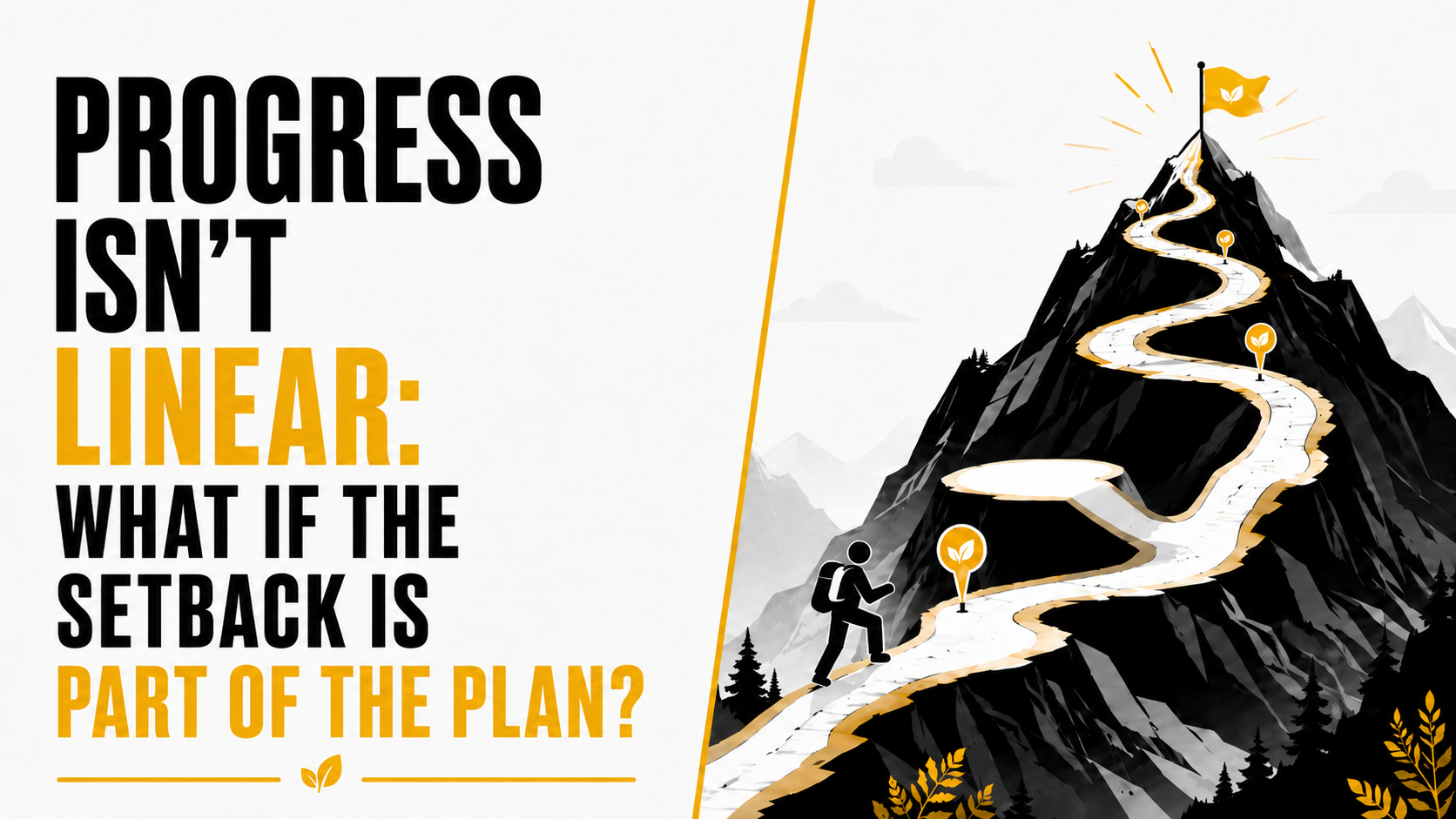
Imagine Climbing a Mountain
Imagine standing at the base of a mountain you’ve never climbed before.
You can see the summit high above you.
You know where you’re trying to go.
So you begin climbing.
At first, the trail rises steadily.
You’re making great progress.
Then something frustrating happens.
The trail flattens out.
A little while later, it actually starts heading downhill.
For a moment, you’re walking away from the very summit you’re trying to reach.
If you judged your progress by that one section of the trail, you’d probably assume you were lost.
But if you could zoom out and look at the entire mountain from above, you’d see something different.
The trail was never taking you away from your destination.
It was simply taking the route required to get there.
Fitness works the exact same way.
The problem is that most people expect progress to look like a staircase.
Instead, it looks much more like a mountain trail.
We Expect Progress to Be a Straight Line
Somewhere along the way, we’ve been sold the idea that progress should happen in a neat, predictable fashion.
Eat healthy.
Lose weight every week.
Lift weights.
Get stronger every workout.
Stay motivated.
Reach your goal.
If only it were that simple.
Real fitness looks different.
Some weeks your weight drops three pounds.
The next week it doesn’t move at all.
You might hit a personal best on the squat this month…
…and feel unusually weak the following week because you’ve been sleeping poorly or working sixty-hour weeks.
You might meal prep perfectly for ten straight days…
…and then have an entire weekend where life completely derails your plans.
None of those moments mean you’ve stopped making progress.
They simply mean you’re climbing a mountain instead of walking a sidewalk.
Why So Many People Quit Too Soon
Here’s what we’ve noticed after years of coaching clients.
Most people don’t quit because they’re incapable.
They quit because they misinterpret normal setbacks as evidence that the plan isn’t working.
The scale goes up for three days.
They panic.
They assume they’ve gained body fat.
They start searching for a different diet.
Or they miss a week of workouts because work gets hectic.
Instead of picking up where they left off, they convince themselves they’ve “fallen off.”
Then Monday becomes next month.
Next month becomes next year.
It wasn’t the setback that stopped them.
It was the story they told themselves about the setback.
More often than not, people don’t quit because they aren’t making progress.
They quit because progress doesn’t look the way they expected it to.
The Scale Was Never Meant to Tell the Whole Story
One of the biggest mistakes people make is treating a single weigh-in like a final exam.
Body weight fluctuates constantly.
Hydration.
Sodium.
Carbohydrates.
Sleep.
Stress.
Hormones.
Digestion.
A tough workout.
All of those can change what the scale says tomorrow morning.
None of them necessarily reflect how much body fat you’ve gained or lost.
That’s why successful coaches rarely obsess over one weigh-in.
We look for trends.
Because trends tell the truth.
Single data points usually don’t.
The Myth of Balance
People love talking about work-life balance.
Fitness-life balance.
Finding balance.
While balance sounds great in theory, life rarely gives us perfectly balanced seasons.
Sometimes…
– Work demands more.
– Your kids need more.
– You’re caring for a sick family member.
– You’re preparing for a bodybuilding show.
– You’re launching a business.
Sometimes life simply asks more of you than usual.
Those seasons aren’t balanced.
They’re intentionally imbalanced.
And that’s okay.
The goal isn’t to create a perfectly balanced life every single day.
The goal is to make sure your health doesn’t disappear every time life becomes demanding.
Maybe your hour-long workouts become thirty-minute workouts.
Or your meal prep gets simplified.
Or your goal shifts from making progress to maintaining momentum.
That’s not failure.
That’s maturity.
People who stay healthy for decades don’t force every season to look the same.
They learn how to adapt without abandoning themselves.
The Fastest Way Back Wins
One of the biggest differences between people who achieve lasting success and those who don’t has nothing to do with genetics.
Or motivation.
Or discipline.
It’s how quickly they recover from a detour.
Everyone…
– Misses workouts.
– Has vacations.
– Has stressful weeks.
– Has meals that weren’t part of the plan.
The difference is what happens next.
One missed workout doesn’t matter.
Missing the next ten because you convinced yourself you ruined your streak does.
One high-calorie meal doesn’t erase months of consistency.
Turning that meal into an entire weekend of giving up might.
The goal isn’t to avoid detours.
The goal is to shorten them.
Because the people who succeed aren’t the people who never get knocked off course.
They’re the people who get back on course the fastest.
Why Coaching and Community Matter
No matter how disciplined you are, there will be days when your emotions are louder than your logic.
A disappointing weigh-in.
A stressful week at work.
A family vacation.
An illness.
A missed workout.
When you’re navigating those moments alone, it’s easy to lose perspective.
A temporary setback starts to feel like permanent failure.
That’s where coaching and community become invaluable.
A coach reminds you to zoom out instead of reacting to one frustrating day.
A community reminds you that you’re not the only person who’s struggled, plateaued, or questioned whether the effort was worth it.
Someone who’s walked the trail before can often see what you can’t.
They can remind you that the switchback you’re standing on isn’t taking you away from your goal – it’s simply part of the climb.
That’s the real value of accountability.
Not someone checking whether you completed your workout.
Someone helping you separate emotion from evidence.
Helping you make thoughtful adjustments instead of emotional decisions.
Helping you stay on the trail when your instinct is to turn around.
That’s exactly what the Lock & Key Collective gives you.
Not because we believe we’ve discovered some secret workout or revolutionary nutrition plan.
We built it because we’ve learned that lasting success rarely comes from having more information.
It comes from having the right people in your corner when progress inevitably gets messy.
Inside the Collective, you’ll find structured training, nutrition guidance, habit coaching, accountability, weekly check-ins, and a community of people pursuing the same long-term mindset.
We can’t promise your journey will be perfectly linear.
No one can.
But we can help you bounce back faster after setbacks so you can keep moving toward the person you’re becoming.
Because progress isn’t linear.
But with the right support system, your direction can be.
Final Thoughts
Every meaningful mountain has switchbacks.
Sections that flatten out.
Trails that seem to move away from the summit before climbing again.
That doesn’t mean you’re lost.
It means you’re on the trail.
Fitness is no different.
There will be weeks where everything clicks.
There will be weeks where you’re simply trying to maintain momentum.
Both count.
Both are part of the journey.
So don’t let one frustrating weigh-in…
One missed workout…
Or one imperfect week convince you you’re starting over.
You’re not.
You’re simply climbing.
Keep putting one foot in front of the other.
Trust the process.
Stay on the trail.
And remember:
The goal isn’t to make progress every single day.
The goal is to keep moving in the right direction over time.
If you’re ready to stop navigating that trail alone, we’d love to walk it with you.
Because no one climbs the biggest mountains alone.
Enrollment for the Lock & Key Collective is open for a limited time; we start September 1st.
After doors close, they won’t be open again until next year.
Tap below to learn more and sign up.