
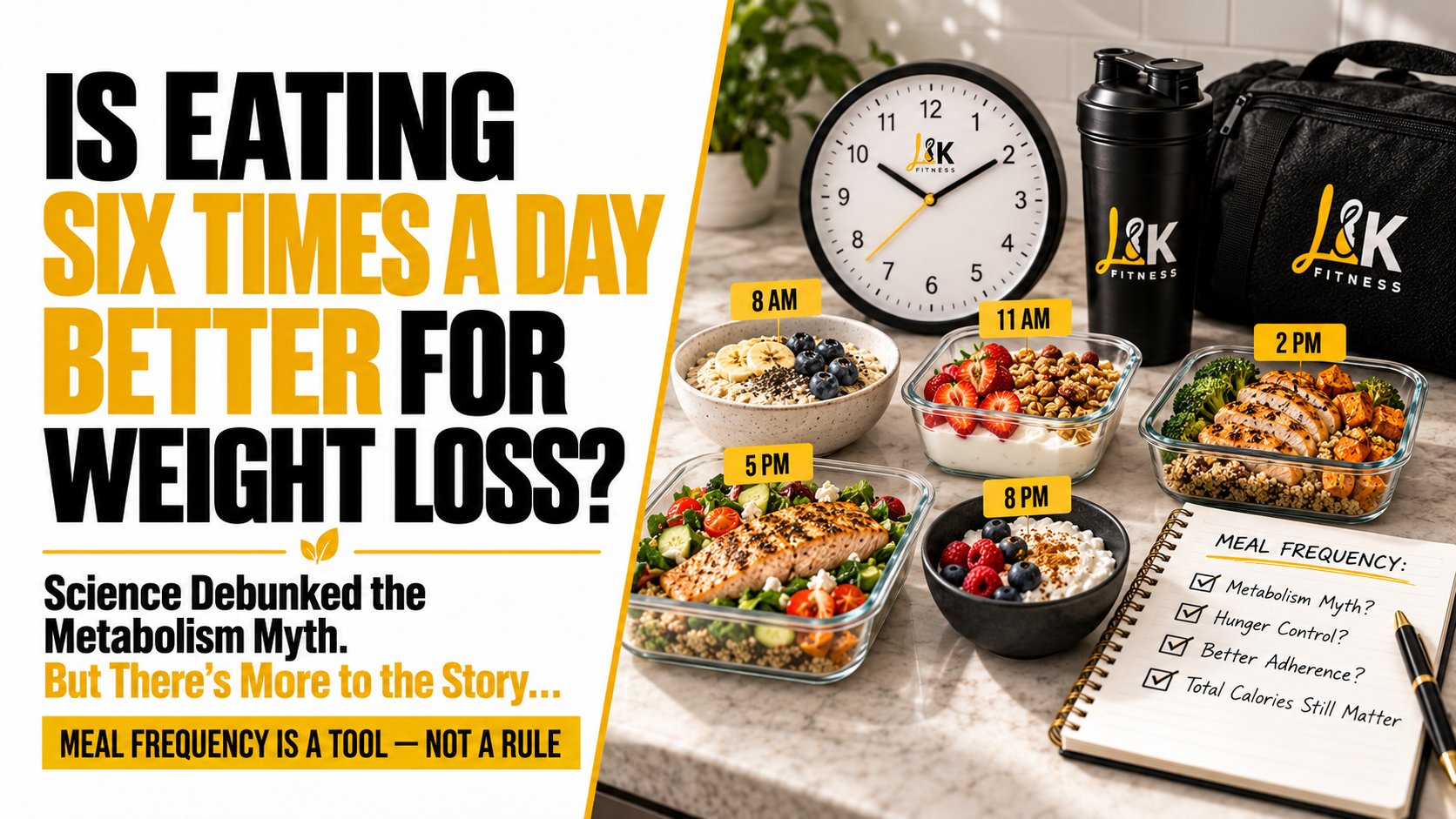
Science “Debunked” the Metabolism Myth. But There’s More to the Story…
If you’ve been around the fitness industry long enough, you’ve probably heard that eating five or six smaller meals throughout the day is the secret to keeping your metabolism running like a furnace.
For years, this was practically gospel in bodybuilding circles. Personal trainers told their fat loss clients this too.
Eat every two or three hours. Keep that metabolic fire burning. Never let your body go too long without food.
And then the research started catching up.
Turns out, eating more frequently doesn’t magically make you burn more calories.
But here’s where things get interesting.
Just because the original explanation was wrong doesn’t necessarily mean the strategy itself was useless.
In fact, eating more frequently can be an effective approach for certain people.
Just not for the reasons we used to think.
Let’s get into it.
First, Let’s Clear Up the Metabolism Myth
Every time you eat, your body expends energy digesting, absorbing, and processing the nutrients in your food.
This is called the thermic effect of food.
And yes, your metabolism temporarily increases after eating.
But here’s what the old bodybuilding advice got wrong:
Eating six smaller meals doesn’t automatically burn more calories than eating three larger meals containing the same total calories and nutrients.
A larger meal generally produces a larger thermic response. A smaller meal produces a smaller one.
Spread the same amount of food across more meals, and the total effect is generally similar.
Research comparing different meal frequencies hasn’t established a meaningful weight-loss advantage to eating more often when overall intake is comparable.
So why would anyone bother eating six times a day?
Because how we organize our meals can influence how consistently we stick to our nutrition goals.
And that’s where the real benefits may lie.
Hunger and Cravings Don’t Always Play Nice
Let’s say you’re trying to lose body fat.
You’re eating in a calorie deficit, and some hunger is probably going to come with the territory.
Now imagine you’ve gone six or seven hours without eating.
You’re hungry. You’re tired. Work was stressful. And suddenly that drive-thru on the way home sounds like the greatest invention in human history.
Sound familiar?
For some people, smaller, more frequent meals make hunger easier to manage.
Instead of waiting until they’re absolutely ravenous, they’ve got another planned meal coming up in a couple of hours.
That can make sticking to their portions and food choices easier.
But this isn’t universal. Some people feel more satisfied eating two or three larger meals.
The goal isn’t to eliminate hunger. It’s to find a meal structure that makes hunger manageable enough to stay consistent.
More Frequent Meals Can Create More Structure
Here’s another potential benefit that has nothing to do with metabolism.
Planning your meals requires some organization.
You need groceries. You need food prepared. You need to think ahead.
And for someone who normally goes all day without eating much, only to come home and demolish half the kitchen, that structure can make a big difference.
It’s not the number of meals creating the magic. It’s making deliberate food choices before you’re starving and scrambling for something convenient.
Of course, preparing six meals can also become a pain in the ass.
If it makes your life unnecessarily complicated, three planned meals might work better.
The important part is having a plan you can realistically follow.
Spreading Out Protein Can Make Life Easier
This is one area where more frequent meals can be especially useful.
Let’s say your daily protein target is 160 grams.
Trying to squeeze that into one or two meals might be uncomfortable or impractical.
But spread it across four meals?
That’s roughly 40 grams per meal.
Suddenly, the goal looks a whole lot more manageable.
Distributing protein across several meals may also help support muscle protein synthesis, although hitting your total daily protein target remains the bigger priority.
And no, your body doesn’t simply stop absorbing protein after 30 grams.
That’s another nutrition myth that refuses to die.
You don’t need six protein feedings per day.
But spreading your protein across meals can make hitting your target easier, especially when your needs are higher.
Your Digestive Comfort Matters, Too
Ever tried cramming a huge amount of food into one sitting because you were trying to hit your macros?
Not always a great experience.
For some people, smaller meals can reduce that uncomfortable, overly full feeling.
This can be especially useful when eating a high-protein diet or trying to consume enough calories to support muscle growth.
Other people tolerate larger meals just fine.
A nutrition plan should work with your appetite, digestion, and schedule – not constantly fight against them.
So, Should You Eat Six Times a Day?
Maybe. But you absolutely don’t have to.
If you enjoy two or three substantial meals, manage hunger well, consistently hit your nutrition targets, and feel great doing it?
Keep doing that.
There’s no reason to complicate something that’s already working.
But if you regularly skip meals, get excessively hungry, struggle with cravings, or have trouble hitting your protein goals, experimenting with more frequent meals might be worthwhile.
And you don’t need to jump straight to six.
Start with three structured meals and a planned snack. Or try four smaller meals.
Then pay attention to a few things:
Are you managing hunger better throughout the day?
Are you consistently hitting your calorie and protein targets?
Are you making fewer impulsive food choices?
Does the schedule actually fit your life?
If the answer is yes, you’ve probably found something useful.
Because here’s the distinction I want you to remember:
A strategy doesn’t need some magical metabolic effect to be effective.
Sometimes its value comes from helping you make better decisions more consistently.
The Best Nutrition Plan Is the One You Can Actually Follow
The fitness industry has a habit of turning useful strategies into rigid rules.
Eat six times a day. Never snack. Skip breakfast. Don’t eat after 7 p.m. Fast for 16 hours.
There’s always another approach being promoted as the one everyone should follow.
But nutrition doesn’t have to be that complicated.
Calories matter. Protein matters. Food quality matters.
And so does your ability to consistently put those things into practice.
Meal frequency is a tool, not a rule.
If eating more frequently helps you manage hunger, plan your meals, and hit your nutrition targets, use it.
If fewer, larger meals work better for you, that’s perfectly fine too.
In The Lock & Key Collective, we help people build nutrition habits that work with their actual lives, not some imaginary perfect schedule.
Because the goal isn’t to follow the most complicated plan.
It’s to find an effective approach you can stick with long enough to see meaningful results.
Sources
The Effects of Eating Frequency on Changes in Body Composition and Cardiometabolic Health in Adults: A Systematic Review With Meta-Analysis of Randomized Trials. 2023. PMID: 37964316.
Impact of Meal Frequency on Anthropometric Outcomes: A Systematic Review and Network Meta-Analysis of Randomized Controlled Trials. 2020. PMID: 32437566.
International Society of Sports Nutrition Position Stand: Meal Frequency. Journal of the International Society of Sports Nutrition, 2011. PMID: 21410984.
Per Meal Dose and Frequency of Protein Consumption Is Associated With Lean Mass and Muscle Performance. 2016. PMID: 27086196.
Mind Pump Media. Episode 2968: Why Eating Six Times a Day Works (Even Though Studies Say It Shouldn’t). October 16, 2026.