
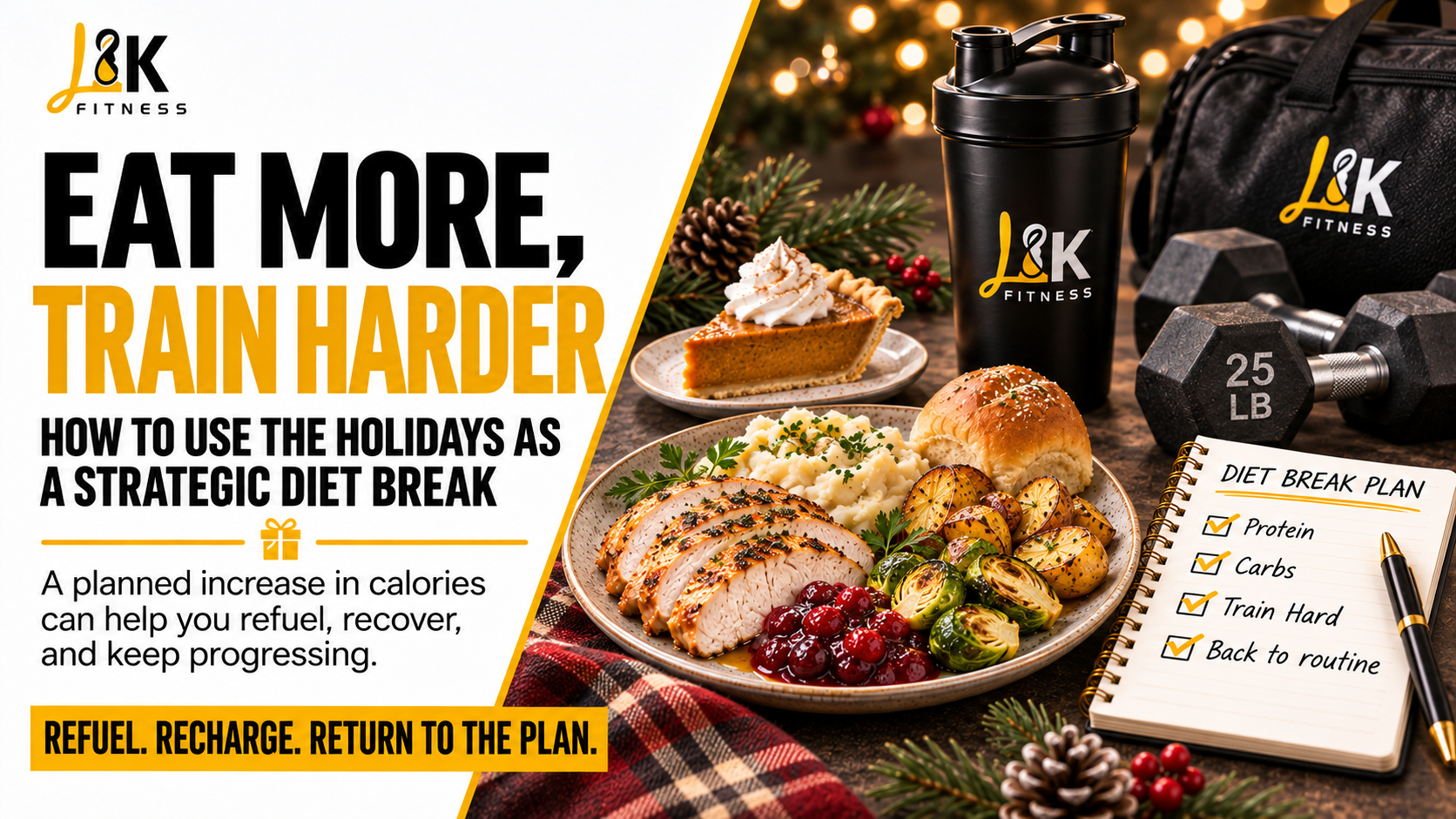
Thanksgiving dinner.
Christmas gatherings.
New Year’s celebrations.
For anyone who’s been working hard to get leaner, the holidays can bring up an interesting question.
What if eating a little more during these celebrations could actually support your long-term fitness goals?
If you’ve been consistently dieting for months, the holidays might be the perfect opportunity to strategically refuel, recharge, and enjoy yourself!
And there’s some interesting science behind why that can be beneficial.
What Happens During a Prolonged Calorie Deficit?
A calorie deficit is what drives fat loss.
But maintaining that deficit for months can take a toll.
Depending on how aggressively you’re dieting, you might experience reduced training performance, slower recovery, increased hunger, and changes in energy levels.
Your body also adapts to weight loss by reducing its energy expenditure.
Some of that happens simply because a smaller body requires fewer calories. Additional metabolic adaptation can occur as well.
Your metabolism isn’t broken. Your body is adapting.
And there’s another side of dieting that deserves just as much attention.
The psychological side.
Diet Fatigue Isn’t Just Physical
Think about everything that goes into maintaining a calorie deficit.
Planning meals.
Tracking calories.
Managing hunger.
Making food choices at restaurants and social gatherings.
And doing it consistently, week after week.
Even when you’re seeing great results, that level of attention can become mentally exhausting.
A planned refeed can offer a welcome break from some of that pressure.
You get to enjoy a little more food, participate in holiday traditions, and spend less time worrying about whether every bite fits your usual calorie target.
For some people, that flexibility can improve their mood, satisfaction, and motivation to continue dieting afterward.
Sometimes the most valuable part of a refeed isn’t what it does for your metabolism. It’s what it does for your mindset.
Of course, this isn’t universal. Some people find that maintaining their usual routine feels easier than temporarily increasing calories.
The right approach is the one that helps you stay consistent over time.
How a Strategic Refeed Works
A refeed is a planned, temporary increase in calorie intake, typically bringing you closer to maintenance calories for a day or two.
For people who lift weights, we generally recommend keeping protein consistent and using much of the additional calorie allowance for carbohydrates.
Why?
Carbohydrates replenish muscle glycogen, the stored fuel your muscles rely on during demanding exercise.
If you’ve been dieting hard, especially with relatively low carbohydrate intake, restoring those stores can help support training performance.
More fuel for challenging workouts.
Better energy through demanding sets.
And potentially better recovery when inadequate fueling has been holding you back.
But here’s an important distinction.
A refeed isn’t a metabolic reset.
Although short-term changes in energy expenditure and appetite-related hormones can occur when you increase food intake, that doesn’t mean a couple of higher-calorie days permanently boost your metabolism.
The benefits are more practical than magical.
What Does the Research Say?
A 2020 randomized trial followed 27 resistance-trained adults during seven weeks of calorie restriction.
One group maintained a continuous deficit.
The other incorporated two consecutive higher-carbohydrate days at approximately maintenance calories each week.
Both groups lost body fat.
But the refeed group preserved more fat-free mass and experienced a smaller reduction in resting metabolic rate.
That’s encouraging for people trying to get leaner while maintaining muscle.
Another study, the MATADOR trial, found that alternating periods of dieting with two-week maintenance breaks produced greater fat loss than continuous restriction in men with obesity.
However, these studies examined structured dieting strategies, not isolated holiday meals.
And the broader research hasn’t consistently shown that refeeds produce greater fat loss.
The evidence suggests that planned increases in calories can be useful tools, but they aren’t required for successful fat loss.
How to Put Your Holiday Refeeds to Work
Here’s how we’d approach Thanksgiving, Christmas, or New Year’s if you’ve been dieting consistently.
1. Aim for Maintenance, Not a Free-for-All
Let’s say you’re currently eating 1,800 calories to lose fat, and your estimated maintenance intake is 2,300.
That gives you approximately 500 additional calories to enjoy.
Keep protein consistent, enjoy some extra carbohydrates, and make room for your favorite holiday foods.
You don’t need to turn Thanksgiving dinner into another carefully measured meal-prep container.
And if you happen to eat a little above maintenance?
One holiday meal isn’t going to erase months of progress.
2. Use the Extra Fuel for Training
If your schedule allows, plan a challenging strength-training session around your higher-carbohydrate day.
Maybe that’s a demanding workout the morning after Thanksgiving.
Or a solid training session following Christmas.
The goal isn’t to burn off the food.
It’s to use the additional fuel to support the training that’s helping you build and maintain muscle.
And if you can’t train that day, don’t sweat it.
Enjoy your time with family and get back to your routine afterward.
3. Expect Some Scale Fluctuations
After a higher-carbohydrate meal, your weight may temporarily increase.
That’s normal.
Stored glycogen carries water with it, and higher sodium intake can also increase water retention.
More food in your digestive system adds weight, too.
A temporary increase on the scale doesn’t automatically mean you’ve gained body fat.
Don’t respond by starving yourself or doing punishment cardio.
Just return to your usual nutrition and training routine.
Think in Months, Not Meals
Here’s the bigger picture.
Successful fat loss isn’t determined by what happens at Thanksgiving dinner.
It’s determined by what happens consistently over time.
And if strategically increasing calories helps you feel better, train more effectively, and maintain the habits that are moving you toward your goals, that’s a worthwhile consideration.
Not because eating more magically accelerates fat loss.
But because a sustainable approach to fitness needs to work physically and psychologically.
The Bottom Line
If you’ve been dieting for months, the holidays can be an opportunity to enjoy yourself while giving your body and mind a little breathing room.
Eat a little more.
Enjoy your favorite foods.
Fuel some productive workouts.
And return to your regular routine afterward.
You don’t have to choose between enjoying the holidays and pursuing your fitness goals.
The best plan is one that allows you to do both.
Inside The Lock & Key Collective, we help you build exactly that kind of approach through structured strength training, practical nutrition coaching, and accountability.
Our next 16-week training round begins January 5, 2027!
Research References
Campbell et al. (2020). Intermittent Energy Restriction Attenuates the Loss of Fat Free Mass in Resistance Trained Individuals: A Randomized Controlled Trial. PMID: 33467235.
Byrne et al. (2018). Intermittent energy restriction improves weight loss efficiency in obese men: the MATADOR study. PMID: 28925405.
Poon et al. (2025). Effects of intermittent dieting with break periods on body composition and metabolic adaptation: a systematic review and meta-analysis. PMID: 38193357.