
Why You Can't Stay Consistent With Working Out – And How To Fix It
If you’ve ever felt fired up to start a fitness routine… only to fall off a few weeks later, you’re so not alone my friend.
It’s human.
Most people don’t struggle with staying consistent because they don’t care enough. They struggle because they never learned how to be consistent with working out in a realistic, sustainable way.
And here’s the truth most fitness influencers skip:
Consistency isn’t about motivation.
And it’s definitely not about punishing yourself into submission.
Workout consistency is a systems problem, not a willpower problem.
In this guide, we’re going to break down:
What consistency actually looks like in fitness
Why consistency matters more than any specific workout plan
Why most people struggle to stay consistent
How to build systems that keep you consistent
Real-life, practical ways to stay consistent with exercises and nutrition
How to create routines that actually stick
By the end, you’ll have a practical blueprint for how to be more consistent, even when life gets chaotic.
Let’s dive in.
What Does “Consistency” Actually Mean?
When people say they want consistency, they often imagine:
Working out every day
Never missing a session
Eating perfectly daily
Always feeling motivated
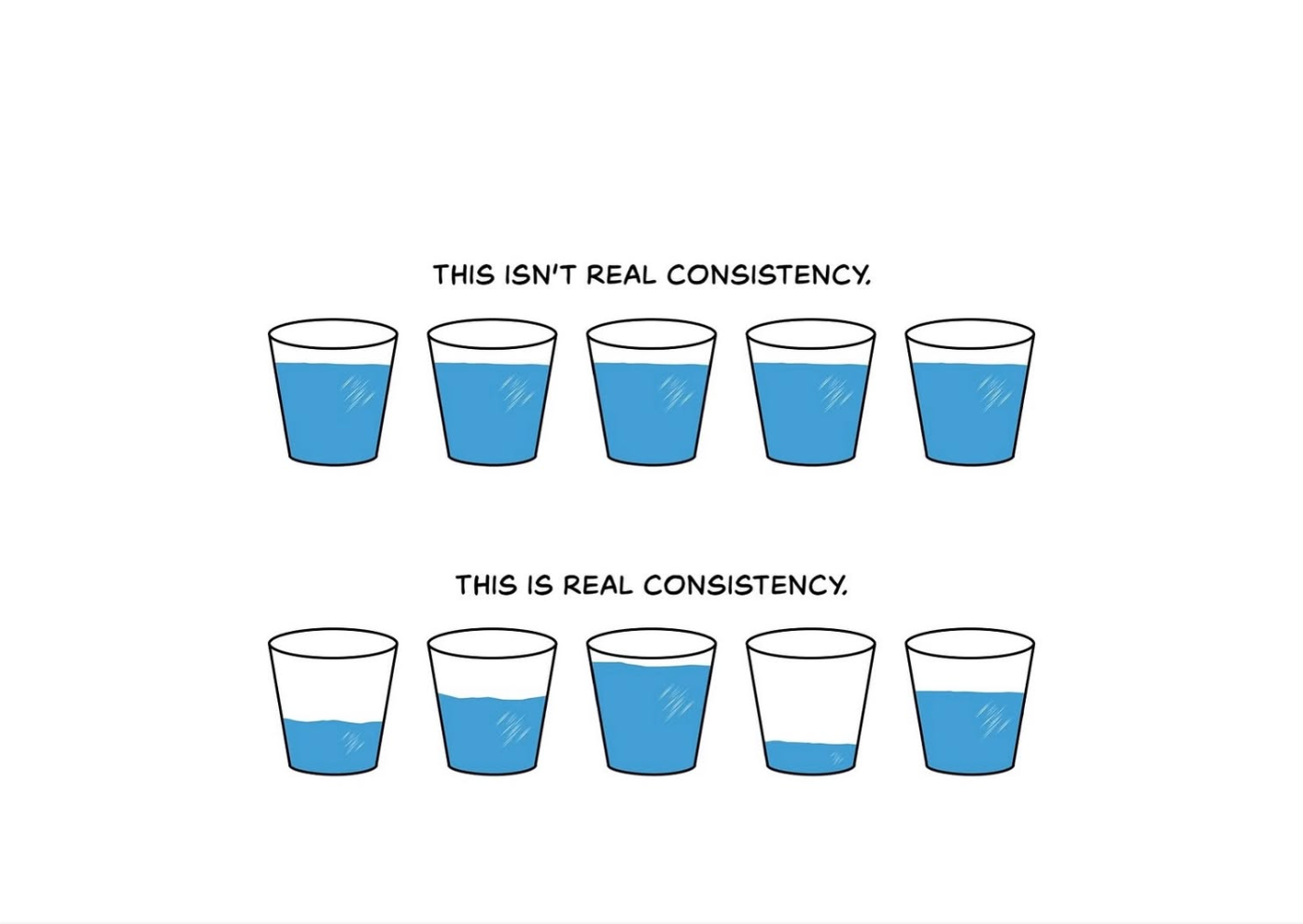
That’s not real consistency.
Real consistency means showing up often enough, for long enough, to make progress.
Consistent exercise habits look like:
Training 3-4 times per week regularly
Getting back on track quickly after missing workouts
Making good nutrition choices and staying on plan at least 80% of the time
Having routines you return to, even after busy weeks
Consistency isn’t perfection.
Consistency is repetition over time.
Research shows that long-term physical activity participation improves cardiovascular health, strength, metabolic health, and longevity (1). But these benefits only occur when movement becomes habitual, not occasional.
So if your goal is:
Fat loss
Muscle gain
Strength
More energy
Better mobility
Injury prevention
Aging well
Then consistency isn’t optional.
It’s the foundation.
Why Consistency Beats Motivation Every Time
Motivation is emotional.
Consistency is behavioral.
Motivation comes and goes. Stressful weeks, bad sleep, work deadlines, family needs – all of these kill motivation.
But systems survive motivation dips.
Studies on habit formation show that behaviors become more automatic through repetition in stable contexts (2). In other words:
When actions are attached to routines, they require less effort over time.
That’s why people who appear “disciplined” usually just have strong systems.
They don’t rely on motivation.
They rely on structure.
Why Most People Struggle With Workout Consistency
Let’s be honest about what usually happens.
Someone decides they want to get in shape. So they:
Join a gym
Download a workout plan
Promise to go everyday
Try to eat perfectly
And for two weeks, things go great.
Then:
Work gets busy
Kids get sick
Sleep drops
Stress rises
Energy crashes
And workouts disappear.
This doesn’t happen because someone lacks discipline.
It happens because:
There was no realistic schedule
No backup plan
No system supporting consistency
Trying harder isn’t the solution.
Building smarter systems is.
Consistency Is a Systems Issue, Not a Willpower Issue
Behavior science shows that when people create implementation intentions – clear plans for when and where behaviors occur – success rates increase dramatically (1).
In practical terms:
Instead of saying,
“I’ll work out more.”
You say,
“I will train Monday, Wednesday, and Friday at 6am before work.”
Specific systems beat vague targets.
If you want to know how to stay consistent with goals, you need to build environments and routines that make action easier.
What Being Consistent Looks Like in Practice
Let’s break down what real-life consistency exercise habits look like.
1. Make a Plan Before the Week Starts
At the start of each week, decide:
Which days you train
What time you train
Where you train
What workout you’ll do
When decisions are made ahead of time, follow-through improves.
When you join the Lock & Key Collective, we give you a proven done-for-you plan that removes guesswork. All you need to do is schedule your workouts on your calendar.
2. Put Workouts on Your Calendar
If workouts aren’t scheduled, they get replaced.
Treat workouts like appointments:
Block the time
Protect it
Show up even when you don’t feel like it
Calendar commitment drives workout consistency.
3. Lower the Barrier to Entry
Make workouts easy to start.
Examples:
Lay out gym clothes beforehand
Keep equipment accessible
Reduce sets or reps when time is tight
Train at home if commute kills consistency
Remember:
Starting matters more than perfection.
4. Remove Friction and Distractions
Distractions kill consistency.
Remove common obstacles:
Prepare meals ahead
Pack gym bags early
Set reminders
Limit evening scrolling that ruins sleep
Small environmental changes make consistency easier.
5. Make Workouts Realistic
Trying to train 6 days per week when life allows 3-4 is a consistency killer.
Choose a plan you can sustain.
Research shows resistance training twice per week can significantly improve strength and muscle mass (3).
You don’t need extreme training.
You need repeatable training.
6. Use Minimum Effective Sessions
Some days, all you can manage is 20 minutes.
That still counts.
Short workouts maintain habit continuity.
Consistency exercise habits are built through frequency, not perfection.
7. Have a “Bounce Back” Plan
Missing workouts isn’t failure.
Quitting after missing workouts is.
A simple rule:
Miss once, resume immediately.
Consistency means recovering quickly.
How to Stay Consistent With Exercises When Life Gets Busy
Life always gets busy.
The solution isn’t waiting for calm periods.
It’s adapting.
Here are practical strategies:
Have Backup Workouts
Keep quick sessions ready:
Bodyweight circuits
Dumbbell workouts
Home training options
Doing fewer sets or reps
Keep Meals Simple
Nutrition consistency matters.
High-protein, whole-food meals improve body composition and recovery (4).
Keep staples ready:
Eggs
Greek yogurt
Chicken
Ground beef
Rice
Frozen veggies
Simple meals beat perfect meals.
Reduce All-or-Nothing Thinking
A missed workout isn’t failure.
Stopping entirely is.
Consistency wins through persistence.
How to Be More Consistent When Motivation Drops
Motivation will drop.
Plan for it.
Use Identity-Based Habits
Instead of saying,
“I’m trying to work out.”
Say,
“I’m someone who trains.”
Identity shapes behavior.
Track Wins
Track workouts, meals, or habits.
When you workout, track how many sets, reps, and weight you used for each exercise in your plan. Taking videos can help track form progress.
When you join the Lock & Key Collective, you can track your sets, reps, form, and progress right in our app.
Write down your training “wins” once per week to enforce positive habits. Visible progress reinforces consistency.
Train With Others
Community improves adherence and accountability.
When you surround yourself with people who have like-minded goals, it reinforces identity.
You still benefit from this with online communities and fitness challenges. Which is exactly why we started the Lock & Key Collective.
The Compounding Effect of Consistency
Consistency may feel small day-to-day.
But over months and years, results compound.
Consistent training leads to:
More muscle mass
Stronger joints
Better metabolism
Higher energy
Better insulin sensitivity
Reduced injury risk
Muscle mass is strongly linked to health and longevity outcomes (5).
Consistency builds muscle.
Muscle supports life quality.
A Simple Weekly Consistency Blueprint
Here’s a realistic model:
Sunday
Plan workouts
Meal prep basics
Schedule workouts on calendar
Monday
Train after work
Eat prepped meal
Wednesday
Train before work
Walk at lunch with friends
Eat prepped meal
Thursday
Train before work
Eat a prepped lunch
Friday
Short workout before work – less sets
Social dinner without guilt
Saturday
Active hobbies or recovery
Grocery Shop
It doesn’t look like much, and that’s the point.
Taking a small amount of time to plan and prep ahead removed most nutrition and exercise decisions for the week. Giving you more time back and reducing mental fatigue.
This is how consistency becomes automatic.
The Real Secret to Crushing Fitness Goals
People often ask how to stay consistent with goals.
The honest answer:
Make consistency easier than quitting.
Build systems where:
Workouts are planned and scheduled
Food is prepared
Distractions are minimized
Routines support action
And most importantly:
Stop expecting motivation to carry you.
Consistency carries you.
Final Thoughts: Consistency Isn’t Sexy – But It Works
Fitness success rarely comes from magic workouts.
It comes from:
Showing up
Doing enough
Repeating it often
Adjusting when life changes
If you’ve struggled with consistency before, that doesn’t mean you can’t build it now.
It just means you need better systems.
Start small.
Make plans.
Schedule sessions.
Reduce friction.
Repeat.
And remember:
Progress doesn’t belong to the most motivated.
It belongs to the most consistent.
References
Gollwitzer, P. M. (1999). Implementation intentions: Strong effects of simple plans. American Psychologist, 54(7), 493–503.
Lally, P., van Jaarsveld, C. H., Potts, H. W., & Wardle, J. (2010). How are habits formed? European Journal of Social Psychology, 40(6), 998–1009.
Peterson, M. D., Rhea, M. R., & Alvar, B. A. (2010). Applications of the dose-response for muscular strength development. Medicine & Science in Sports & Exercise, 42(2), 378–385.
Phillips, S. M., & Van Loon, L. J. (2011). Dietary protein for athletes. Journal of Sports Sciences, 29(sup1), S29–S38.
Srikanthan, P., & Karlamangla, A. S. (2014). Muscle mass and mortality. American Journal of Medicine, 127(10), 940–951.
6. Warburton, D. E., Nicol, C. W., & Bredin, S. S. (2006). Health benefits of physical activity. CMAJ, 174(6), 801–809.